

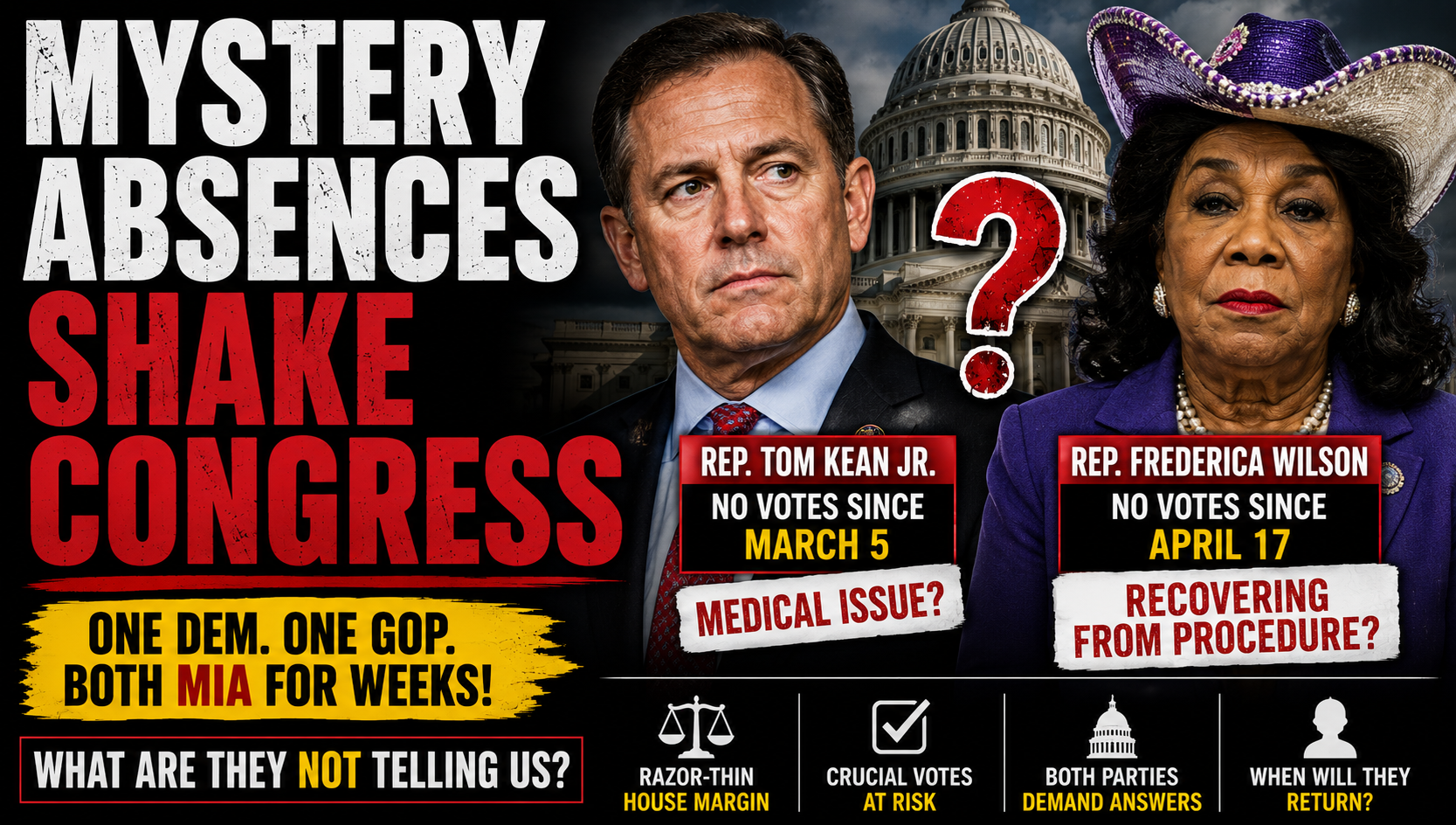
Concern is quietly growing on Capitol Hill as two members of Congress — one Republican and one Democrat — have vanished from the House floor for weeks amid vague explanations about undisclosed health issues.
With the House operating on razor-thin margins and major legislation looming, the unexplained absences are beginning to create anxiety in both parties.
Tom Kean Jr., a 57-year-old Republican representing a highly competitive New Jersey swing district, has not cast a vote since March 5. His office has only described the matter as a “personal medical issue,” offering little additional information.
Meanwhile, Frederica Wilson, the 83-year-old Florida Democrat known for her colorful hats and outspoken media appearances, has been absent since April 17 following what Democratic leadership called a medical procedure.
The unusual situation has sparked mounting speculation in Washington because neither absence was broadly discussed publicly for weeks despite the stakes involved.
The House currently operates under extremely narrow margins, meaning even a single missing member can dramatically impact the outcome of major votes.
Republicans, in particular, are facing growing pressure as they prepare legislation related to border enforcement and immigration funding. Party leaders can reportedly afford to lose no more than two Republican votes on strictly partisan measures.
That reality makes Kean’s disappearance especially significant.
Speaker Mike Johnson told reporters he spoke with Kean roughly two weeks ago and said the congressman “sounded great,” but acknowledged he still has little understanding of the underlying issue.
“It’s a personal thing,” Johnson reportedly said. “We’re praying for him, and I need him to get back as soon as he can.”
Yet despite assurances from Kean’s team that he would return to a “full schedule” in the near future, the congressman remained absent as lawmakers reconvened this week.
The lack of transparency has fueled questions not only about the lawmakers’ health, but also about whether Congress has become too secretive regarding the medical fitness of elected officials.
Americans have increasingly watched aging political figures remain in office despite visible physical or cognitive decline, while leadership in both parties often shields details from the public until situations become impossible to ignore.
That concern intensified after several high-profile incidents in recent years involving lawmakers freezing during speeches, suffering public medical episodes, or disappearing from public duties for extended periods with minimal explanation.
Wilson’s absence reportedly went largely unnoticed until veteran congressional reporter Jamie Dupree highlighted it publicly on social media, forcing reporters to ask House Minority Leader Hakeem Jeffries about her whereabouts.
Jeffries responded that Wilson was “recovering from a procedure” and would “be back shortly.”
Still, many observers are asking a broader question:
Should members of Congress — whose votes can determine national policy, spending, war powers, and border security — be required to provide greater transparency about prolonged absences?
The issue becomes even more serious in an era where control of Congress can hinge on just a handful of seats.
Kean’s district is considered politically competitive heading into the next election cycle, meaning any prolonged health uncertainty could have ripple effects not just for legislation now, but for the future balance of power in Washington.
For the moment, both parties are publicly projecting calm.
Privately, however, lawmakers know every missing vote matters.