

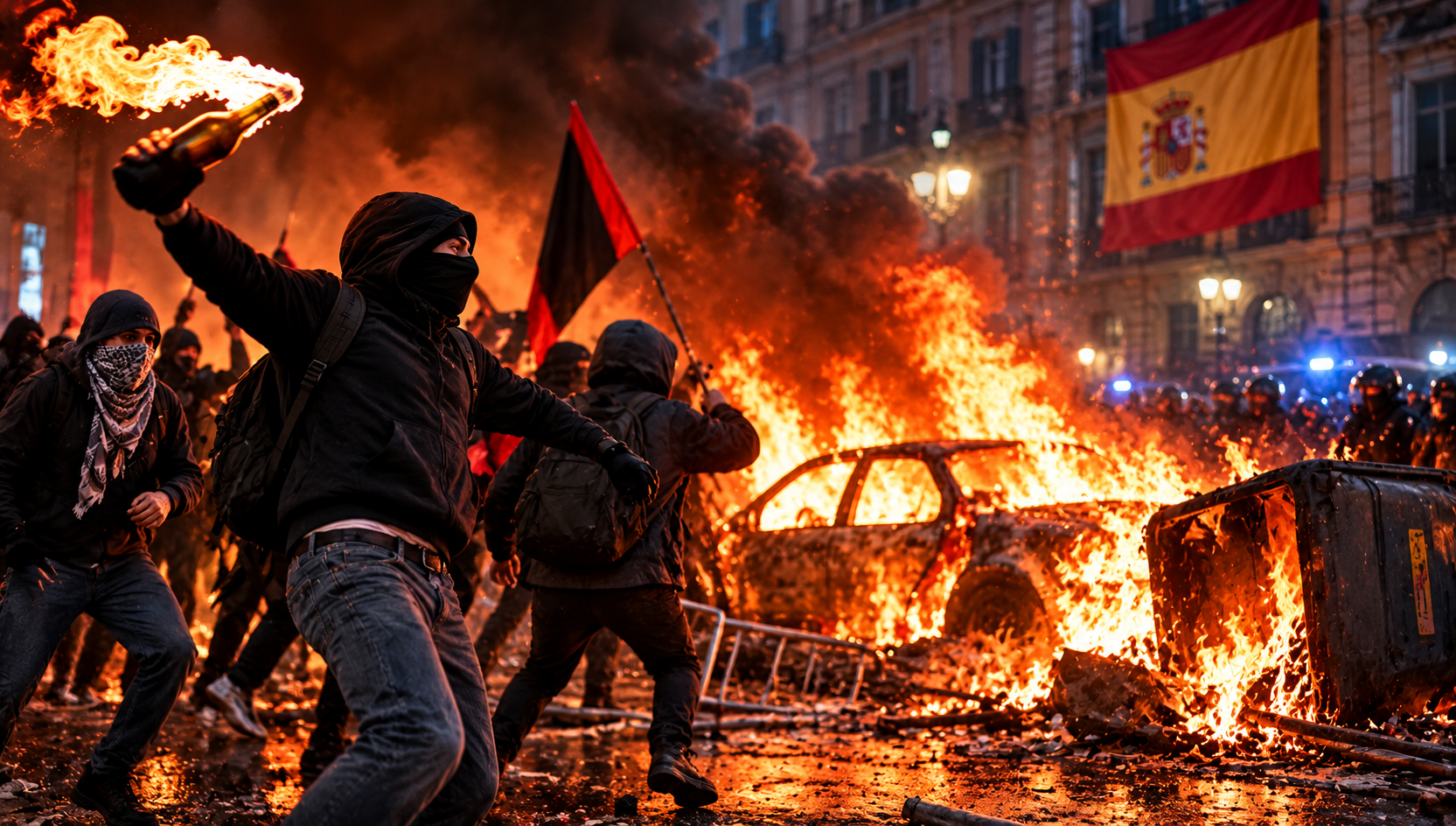
Cars burned, businesses were looted, and 19 people were arrested after left-wing activists took to the streets of Bilbao to protest a conservative commentator’s campus appearance.
Spain’s self-proclaimed defenders of tolerance have found an unusual way to combat opinions they dislike: setting cars on fire.
Violence erupted Monday evening in Bilbao, northern Spain, when far-left activists descended on the city to protest a scheduled appearance by conservative journalist and political commentator Vito Quiles at the University of Deusto.
By the time the unrest subsided, vehicles had been torched, businesses looted, public property destroyed, and 19 people arrested.
Seven of those arrested were minors.
The demonstrators claimed to be fighting fascism. Their methods told a rather different story.
Two Thousand Protesters, One Conservative Speaker
The demonstration was organized by left-wing groups, including the Socialist Youth of the Basque Country, alongside organizations identifying themselves as anti-fascist.
Their target was Quiles, a provocative conservative commentator whose appearances at Spanish universities have repeatedly attracted protests.
Approximately 2,000 people, many of them students, gathered to oppose his planned appearance.
The Socialist Youth declared that Quiles was not welcome and insisted they would not allow his supposed hatred and intolerance to influence young people.
Apparently, the preferred alternative was burning vehicles and smashing up the neighborhood.
What began as a political demonstration descended into violent confrontations, with rioters reportedly setting fires, damaging street furniture, and looting businesses.
The Basque Country’s autonomous police force, the Ertzaintza, arrested 19 suspects, including seven minors and several young adults.
The violence ultimately achieved what the protesters had demanded: Quiles canceled his appearance.
Free Speech, Unless the Mob Disagrees
Quiles said police had warned him of an exceptionally high risk of violence surrounding the event.
He also alleged that former members of ETA, the Basque separatist terrorist organization, were involved in organizing the unrest. That accusation has not been independently established.
“Freedom of expression is sacred,” Quiles said, explaining that he could not justify exposing his supporters to potentially dangerous confrontations.
He later accused the demonstrators of behaving like the very extremists they claimed to oppose.
The episode raises an uncomfortable question.
What does anti-fascism mean when its practitioners use intimidation and violence to prevent a political opponent from speaking?
Disagreeing with Quiles is perfectly legitimate. Protesting his appearance is equally legitimate. Threatening violence until the event is canceled is something else entirely.
The distinction should not be difficult to understand.
Bilbao’s Mayor Calls Out the Hypocrisy
Even Bilbao’s mayor, Juan Mari Aburto of the Basque Nationalist Party, had little patience for the rioters.
“They are not anti-fascist; they are authentic fascists,” he declared.
Aburto expressed sympathy for business owners whose shops had been looted, residents whose vehicles had burned, and ordinary citizens forced to endure the chaos.
His condemnation was particularly notable because it came from a politician outside Spain’s conservative opposition.
The destruction was not merely a dispute between rival political movements. It affected residents and business owners who had nothing to do with the controversy.
Meanwhile, Alberto Núñez Feijóo, leader of Spain’s conservative Popular Party, condemned the violence and promised a government committed to restoring public order.
Spain’s Growing Problem With Political Violence
The Bilbao disturbances followed another outbreak of unrest in Barcelona just two nights earlier.
That incident reportedly resulted in 128 arrests and widespread damage to businesses.
Quiles’ campus tour has also encountered disruptions in Pamplona, Zaragoza, and at the Autonomous University of Barcelona.
The recurring pattern is troubling.
A controversial speaker announces an appearance. Activists mobilize to stop it. Tensions escalate. Police intervene. The event is disrupted or canceled.
And the people who claim to be defending democracy celebrate preventing someone else from exercising one of its most basic freedoms.
Spain is hardly alone in confronting this problem. Across Western democracies, political intimidation has increasingly become a substitute for argument among some extremist movements.
The danger is not simply the destruction of property. It is the precedent established when threats of violence determine who gets to speak.
The Irony Is Almost Too Obvious
There is nothing inherently fascist about opposing a conservative commentator. There is nothing undemocratic about organizing a peaceful demonstration against someone whose politics you despise.
But there is something profoundly authoritarian about deciding that political disagreement justifies intimidation, destruction, and the silencing of opponents.
The rioters in Bilbao did not defeat Quiles in an argument.
They helped make his appearance too dangerous to proceed.
That is not a victory for tolerance. It is a victory for intimidation.
And if a political movement can only defend its ideas by preventing competing ideas from being heard, perhaps its greatest fear is not fascism.
Perhaps it is debate.