

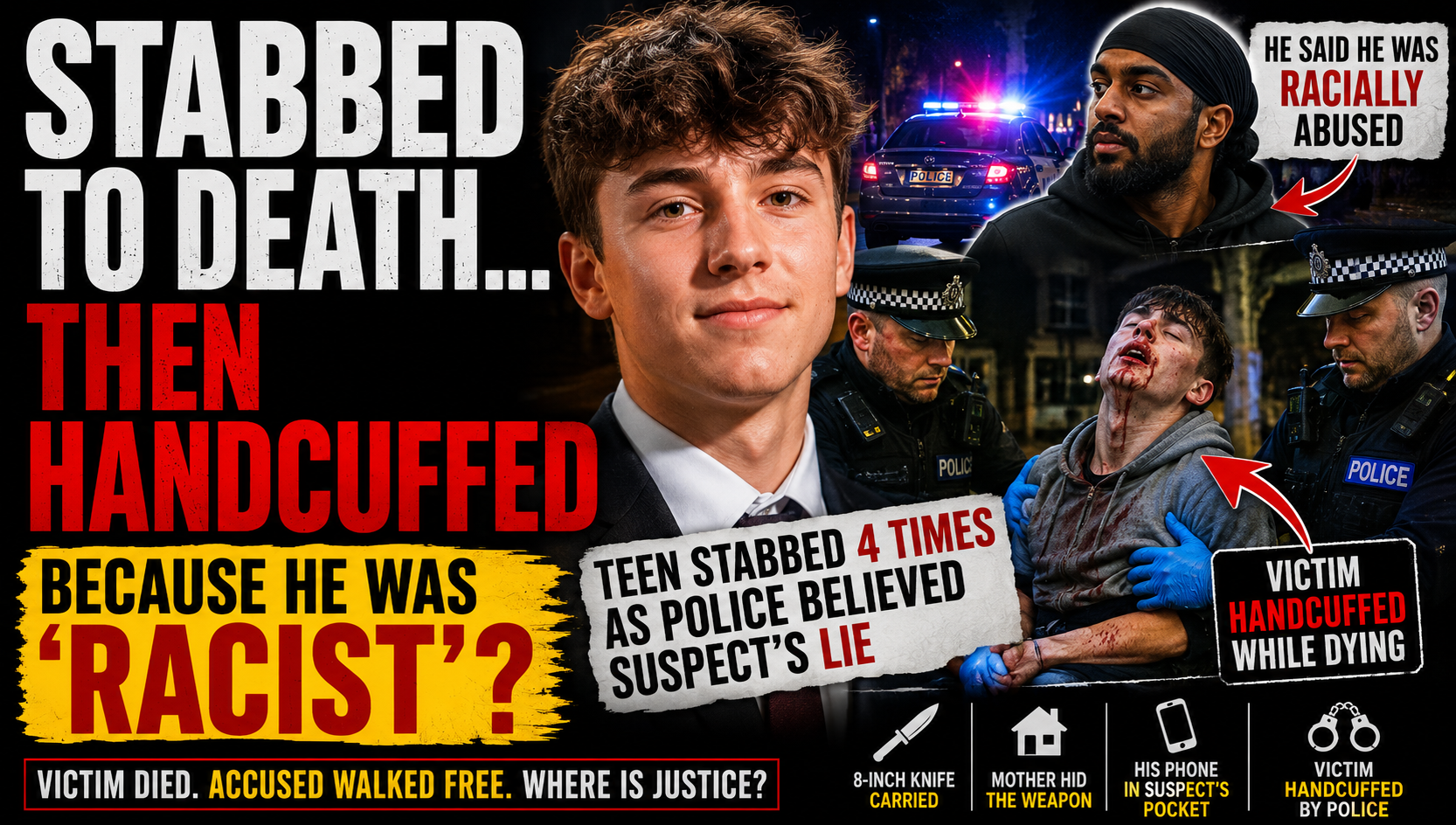
A British murder trial is raising explosive questions about modern policing after a teenage stabbing victim was allegedly handcuffed by officers while bleeding to death — because the suspected attacker claimed he had been the victim of racism.
The case centers around 19-year-old university student Henry Nowak, described in court as an athletic undergraduate of Anglo-Polish heritage who had been out socializing with friends before encountering 23-year-old Vickrum Digwa on a street late at night.
According to prosecutors, what happened next became a catastrophic failure of judgment.
Jurors heard that Digwa was allegedly carrying an “extremely large” knife across his chest when the two exchanged words. A mobile phone video recorded by Nowak reportedly captured him mocking Digwa’s self-described “bad man” image moments before the confrontation escalated.
Witnesses later testified that Nowak could be heard saying he had been stabbed and was dying as he attempted to flee.
Prosecutors say Digwa aggressively pursued him.
But the most shocking part of the case may be what happened after police arrived.
According to testimony presented in court, Digwa allegedly told responding officers that he had been racially abused and attacked by a drunken man. Despite Nowak insisting that he was the actual victim and had been stabbed, officers reportedly handcuffed him at the scene.
Moments later, he collapsed and died.
A post-mortem examination found four stab wounds. Prosecutors told the jury that one wound pierced his lung so deeply that the teenager “drowned in his own blood.”
The prosecution summarized the incident bluntly:
“Instead of seeking help for the man he had injured with his sizeable knife, he accused him of being a racist and being drunk.”
The case has rapidly become symbolic of a broader public frustration in Britain and across the West: the fear that accusations of racism now influence institutional behavior so heavily that basic facts can become secondary in fast-moving situations.
Critics argue that officers appeared more concerned with the optics of a racial allegation than determining who was actually bleeding to death in front of them.
That perception is only intensified by additional details emerging during the trial.
The court heard that Nowak’s mobile phone was later allegedly found in Digwa’s pocket. Prosecutors further claim that Digwa’s mother, 53-year-old Kiran Kaur, removed the alleged murder weapon from the scene and hid it at her nearby home, where police later discovered what reports described as an “arsenal of weapons.”
Kaur now faces charges of assisting an offender.
The defense argues Digwa acted in self-defense during a heated altercation and says the knives he carried were lawful due to his Sikh faith, which traditionally permits adherents to carry ceremonial blades known as kirpans.
But prosecutors say Digwa was allegedly carrying not only ceremonial kirpans, but also a much larger eight-inch shastar knife prosecutors argue went far beyond religious necessity.
The trial continues, but the facts already revealed are deeply disturbing.
A teenager reportedly begged for help while handcuffed.
Police allegedly restrained the dying victim while the accused killer framed himself as the victim.
And once again, Britain finds itself confronting an uncomfortable question:
Have authorities become so terrified of accusations involving race that instinct, evidence, and common sense are sometimes pushed aside in real time?
For many observers, the death of Henry Nowak is no longer just a murder case.
It is becoming a symbol of institutional paralysis in an era where the wrong accusation may matter more than the obvious truth unfolding in front of everyone’s eyes.