

The world’s most critical oil artery just turned into a live fire zone.
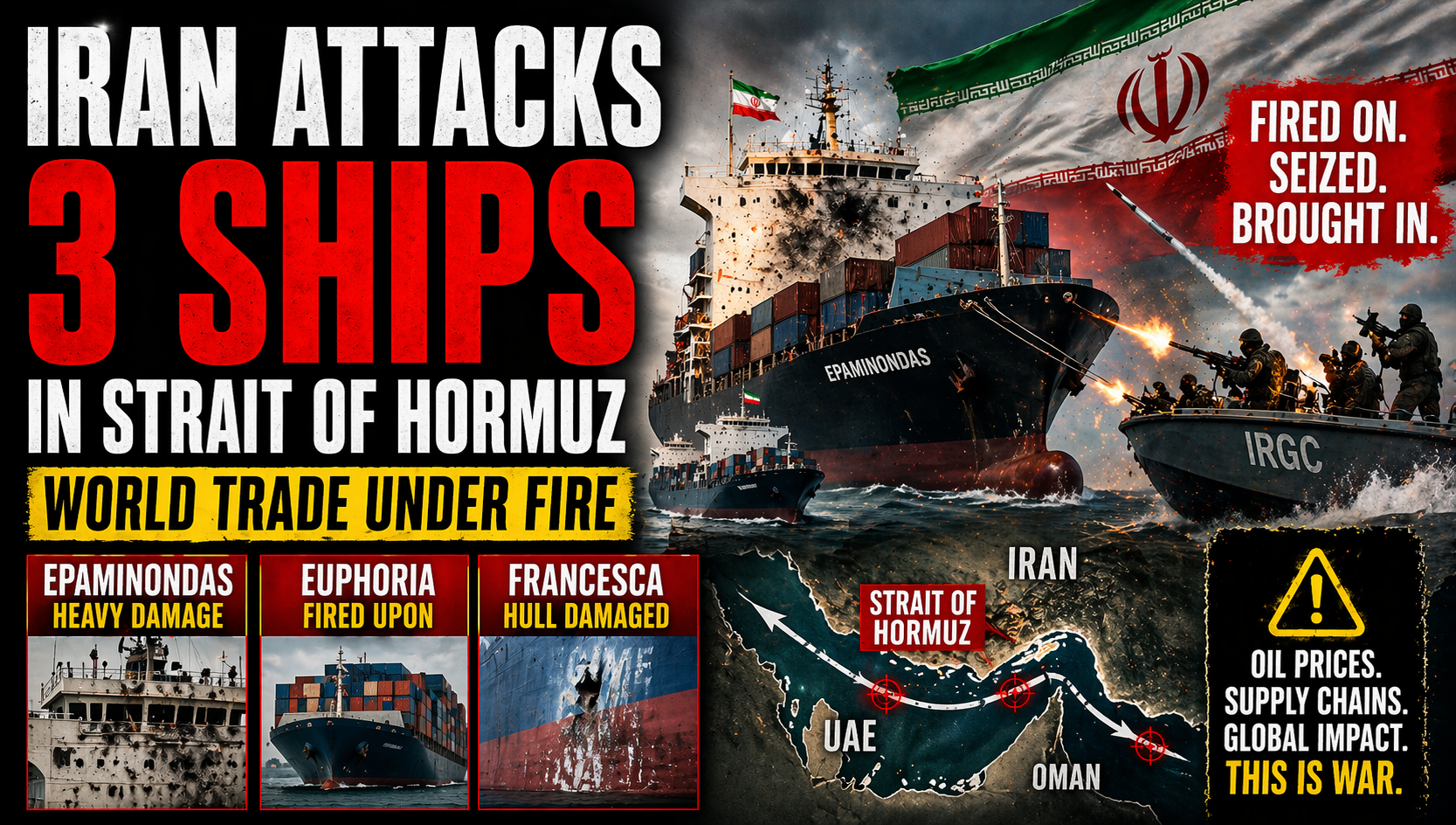
In a stunning escalation, Iran’s Islamic Revolutionary Guard Corps (IRGC) launched coordinated attacks on at least three commercial container ships attempting to pass through the Strait of Hormuz — the narrow chokepoint that carries nearly a fifth of the world’s oil supply.
This wasn’t a warning shot. It was a message.
Ships Targeted, Fired On, and Seized
According to Britain’s maritime authorities, the Greek-owned container ship Epaminondas was approached by an IRGC gunboat and fired on without warning. The bridge took heavy damage. Only luck — or restraint — kept the crew alive.
Hours later, a second vessel, the UAE-owned Euphoria, was also engaged and forced to stop.
Then came the third strike.
The MSC-operated Francesca was reportedly hit with gunfire and rocket-propelled grenades before being ordered to drop anchor.
Three ships. Three separate incidents. One clear signal.
Iran is no longer just threatening the Strait of Hormuz. It is actively policing it with force.
A Chokepoint Under Siege
The Strait of Hormuz is not just another shipping lane. It is the artery of global trade. Roughly 20 percent of the world’s oil flows through this narrow stretch of water.
Disrupt it, and you don’t just hit tankers. You hit global energy markets, supply chains, and economic stability.
And now, Iran appears willing to do exactly that.
Iran’s Justification — and the Reality
Tehran claims the ships were violating maritime rules, even accusing some of ties to Israel and alleging they were operating “illegally” or “without authorization.”
But Western reports paint a different picture.
At least two of the vessels were fired upon without warning. One was reportedly “running dark” — a tactic used in high-risk waters to avoid detection — but still believed it had permission to transit.
Iran says enforcement. Others see escalation.
Small Boats, Big Consequences
Perhaps most alarming is how these attacks were carried out.
Not with large naval destroyers or sophisticated missile systems, but with small, fast boats armed with infantry weapons and rocket-propelled grenades.
That matters.
Because it means these attacks are:
- Cheap
- Repeatable
- Difficult to deter
In other words, this is asymmetric warfare at sea — and it can scale fast.
The Scam That Signals Chaos
Adding another layer of instability, reports have surfaced of scammers posing as Iranian officials selling “safe passage” through the Strait — in cryptocurrency.
At least one tanker reportedly paid for protection… and was attacked anyway.
That’s not just fraud. It’s a sign of a system breaking down, where even the illusion of control is being monetized.
What Comes Next
This is no longer a theoretical risk.
We are watching the early stages of a maritime standoff between Iran and the United States, with both sides effectively attempting to deny each other access to one of the most important waterways on Earth.
The implications are massive:
- Oil prices could spike overnight
- Global shipping could reroute or stall
- Military confrontation becomes more likely with each incident
And all it takes is one miscalculation.
The Bottom Line
This wasn’t an isolated incident.
It was a coordinated show of force in the most strategically sensitive waterway in the world.
The Strait of Hormuz is no longer just tense.
It’s active.