

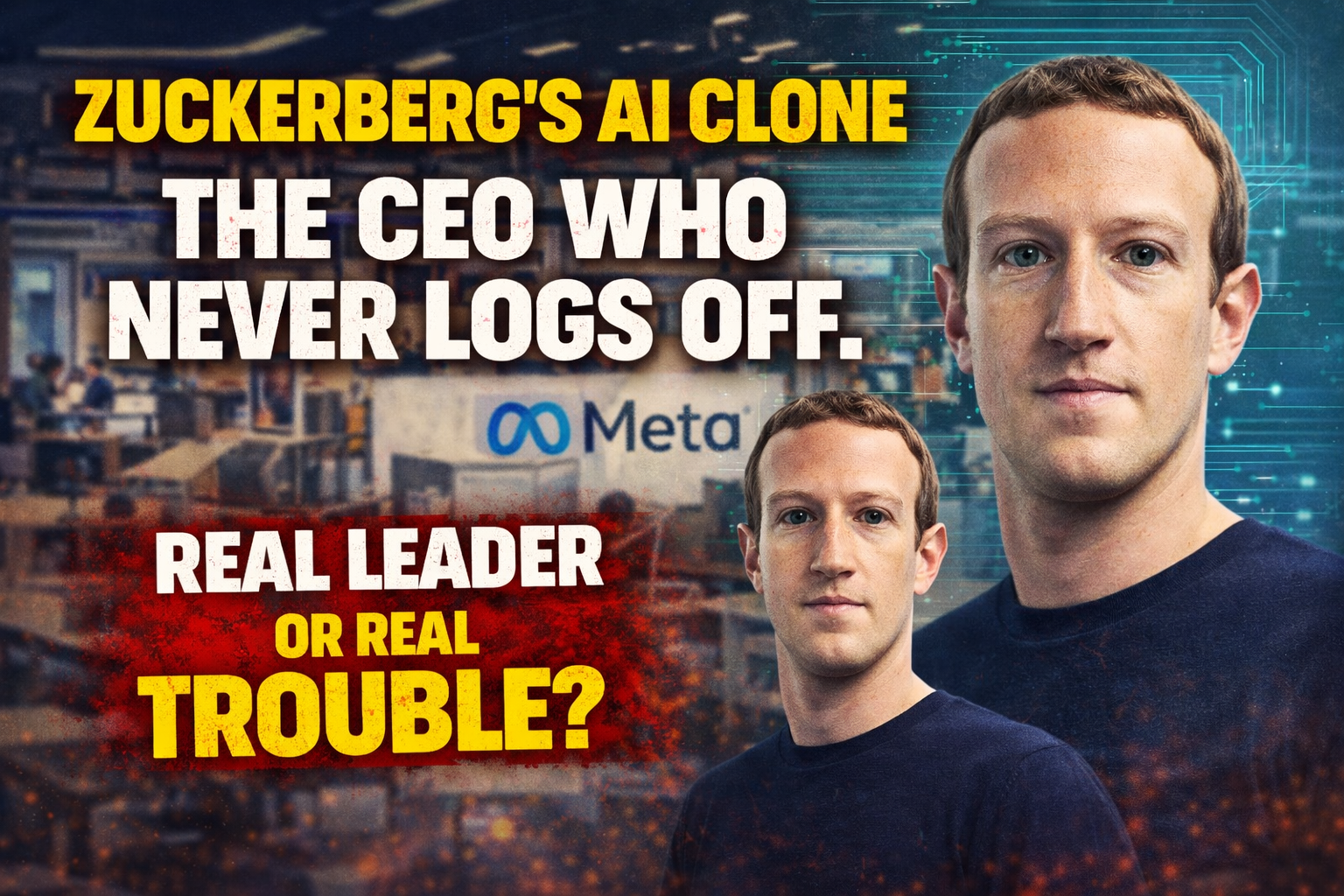
There was a time when the boss left the office at the end of the day.
Not anymore.
According to reports, Mark Zuckerberg and his company Meta are developing something that sounds less like a productivity tool and more like a glimpse into the future of corporate life: an AI-powered clone of Zuckerberg himself.
Not a chatbot. Not a digital assistant.
A photorealistic, interactive version of the CEO, trained to think, speak, and respond like him.
The Boss, Recreated
The project, still in early development, aims to create a fully interactive AI character modeled on Zuckerberg’s personality, tone, and decision-making style.
This isn’t just surface-level imitation. The AI is reportedly being trained on:
- His public statements
- His internal thinking on company strategy
- His communication patterns and mannerisms
The goal is simple, at least on paper: allow employees to interact with “Zuckerberg” directly, receiving feedback, guidance, and possibly even direction without the real person being involved.
In other words, the CEO becomes scalable.
Always Watching, Always Available
Zuckerberg is said to be deeply involved in the project, spending hours each week coding and reviewing AI systems.
That alone tells you something.
This isn’t a gimmick. It’s a priority.
And it fits into a broader push inside Meta to integrate AI into every layer of the company. This includes separate efforts to build a “CEO agent” that assists Zuckerberg himself, creating a strange feedback loop where both the leader and his digital twin operate simultaneously.
One runs the company.
The other might soon run the people inside it.
From Social Media to Synthetic Personalities
This isn’t Meta’s first attempt at digital personas.
Back in 2023, the company rolled out AI chatbots modeled after celebrities, including Snoop Dogg, allowing users to interact with simulated personalities.
Then came AI Studio, a platform where users could build their own digital characters or even AI versions of themselves.
The results were… mixed.
Reports quickly surfaced of users creating inappropriate and explicit AI personas, raising serious concerns about regulation, safety, and the psychological effects of interacting with synthetic identities.
Meta responded by tightening access, especially for younger users.
But the trajectory didn’t change.
If anything, it accelerated.
The Bigger Shift No One’s Talking About
What happens when leadership itself becomes artificial?
When employees don’t just report to a manager, but to a simulation of the founder?
When feedback, mentorship, and even corporate culture are filtered through an algorithm trained to mimic a single individual?
This isn’t just about efficiency.
It’s about replication.
About turning human leadership into something programmable, repeatable, and scalable.
And once that exists, it doesn’t stay contained.
Isolation, Automation, and the Human Cost
There’s another layer here, one that often gets overlooked in the rush toward innovation.
The rise of AI companions and digital personas isn’t happening in a vacuum. It’s emerging alongside a growing loneliness epidemic.
Studies have shown that a significant portion of adults report feelings of isolation, with younger generations being hit the hardest.
Critics argue that AI interactions, while convenient, may deepen that isolation rather than solve it.
Instead of real conversations, you get optimized ones.
Instead of human connection, you get simulation.
And now, instead of a real boss, you may soon get a digital one.
The Line That’s Being Crossed
It’s easy to frame this as progress.
Faster communication. More access. Greater efficiency.
But there’s a deeper question lurking beneath it all:
At what point does convenience replace reality?
Because once the CEO becomes an algorithm, the company stops being just a workplace.
It becomes something else entirely.
Something where the line between human and machine isn’t just blurred.
It’s erased.