

The story sounds like something pulled straight out of a Cold War thriller. But for a growing number of observers, it’s becoming harder to ignore.
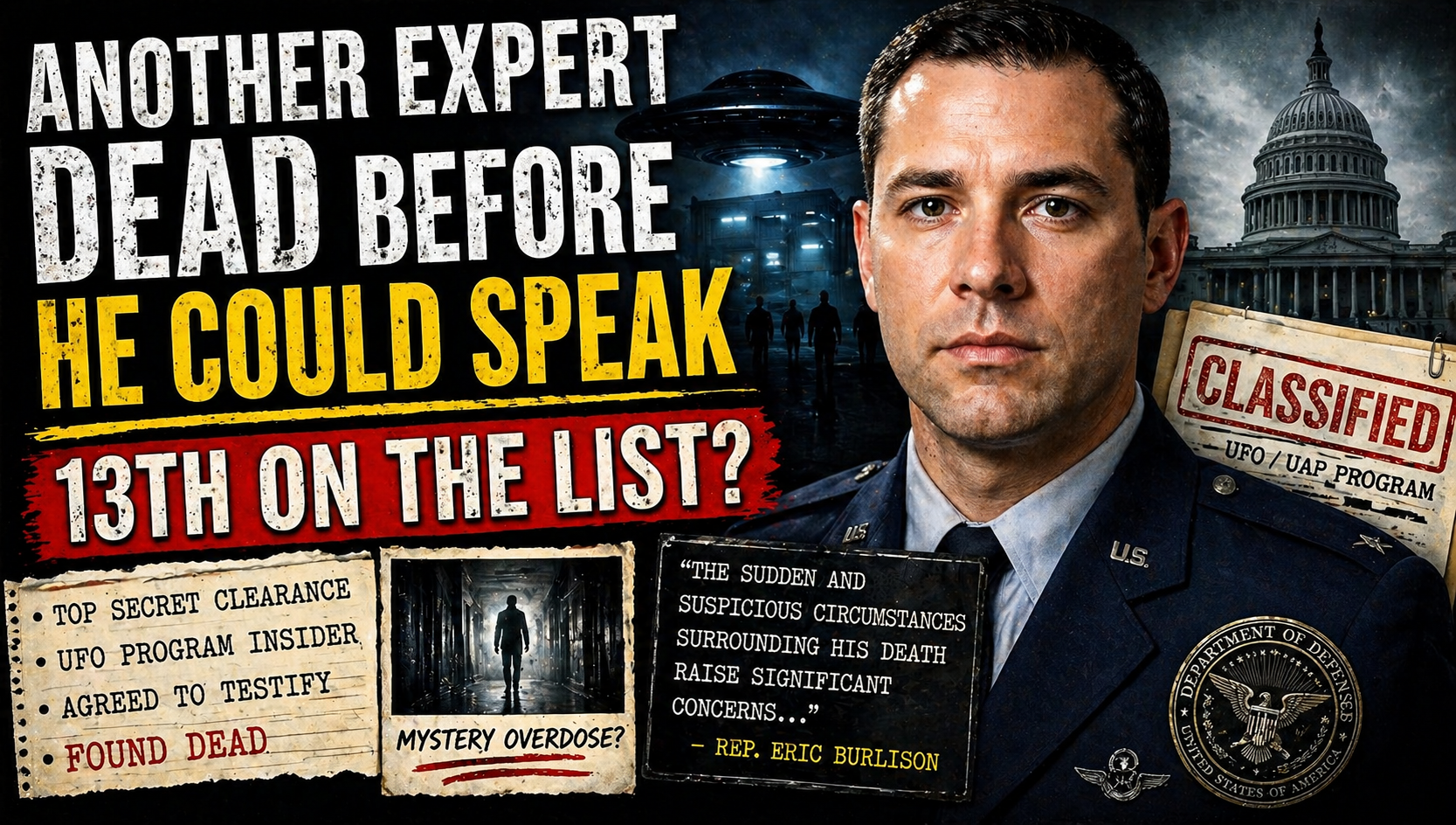
Matthew James Sullivan, a 39-year-old Air Force veteran with a background in highly classified intelligence programs, was reportedly preparing to testify before Congress about alleged UFO—or UAP—programs. Months before that testimony could happen, he was found dead in his Virginia home.
The official ruling: accidental drug overdose.
According to the Northern District Office of the Chief Medical Examiner, Sullivan died from a lethal combination of alcohol and prescription medications, including alprazolam, cyclobenzaprine, and imipramine. All legal drugs. All commonly prescribed. On paper, the case appears straightforward.
But the timing is what’s raising eyebrows.
Sullivan wasn’t just another veteran. He had served in Operation Enduring Freedom, earning a Bronze Star for valor, and later held positions within some of the most sensitive corners of the U.S. intelligence world, including the Air Force Intelligence Agency, the National Air and Space Intelligence Center, and the National Security Agency.
In other words, he wasn’t on the outside looking in. He was on the inside.
And according to reports, he was preparing to speak publicly about what he knew.
That’s where things begin to get murky.
Missouri Congressman Eric Burlison has called Sullivan’s death a matter of “grave concern,” even referring it to the FBI due to potential national security implications. In a letter to FBI Director Kash Patel, Burlison pointed to the “sudden and suspicious circumstances” surrounding the death, especially given Sullivan’s anticipated testimony.
The FBI has not confirmed details but has acknowledged broader efforts to examine possible connections among a number of deceased or missing scientists and experts, many of whom reportedly had access to classified information.
Depending on how the list is counted, that number now sits somewhere between 10 and 12 individuals.
Sullivan may be the latest name added.
Of course, correlation is not proof. In any field involving classified work, high stress, and complex personal lives, tragedies do happen. Experts caution against jumping to conclusions based solely on timing or association.
But the pattern—real or perceived—is what keeps the story alive.
Adding to the intrigue are claims from other whistleblowers. Perhaps the most well-known is David Grusch, a former Air Force intelligence officer who testified before Congress in 2023. Grusch alleged that the U.S. government possesses recovered UAP materials, including what he described as “non-human biologics.”
He also stated that he faced retaliation after coming forward.
That claim alone has fueled speculation that individuals connected to these programs may face pressure, intimidation, or worse. However, no conclusive evidence has emerged linking any deaths to coordinated foul play.
Still, Sullivan’s case adds another layer to an already complex situation.
At his funeral, retired Major General David Abba remarked that Sullivan carried “the burden that a select few in this nation have of truly understanding what’s going on.” It’s a striking statement, one that hints at knowledge most people never come close to accessing.
Whether that knowledge played any role in his death remains unknown.
For now, the facts remain limited. An official ruling of accidental overdose. A man with deep ties to classified programs. A scheduled congressional testimony that never happened. And a growing list of others whose circumstances continue to raise questions.
It may all be coincidence.
Or it may be something more.
Until investigations—if they happen—produce clearer answers, the story sits in that uncomfortable space between documented fact and unanswered questions.
And that, more than anything, is why it refuses to go away.