

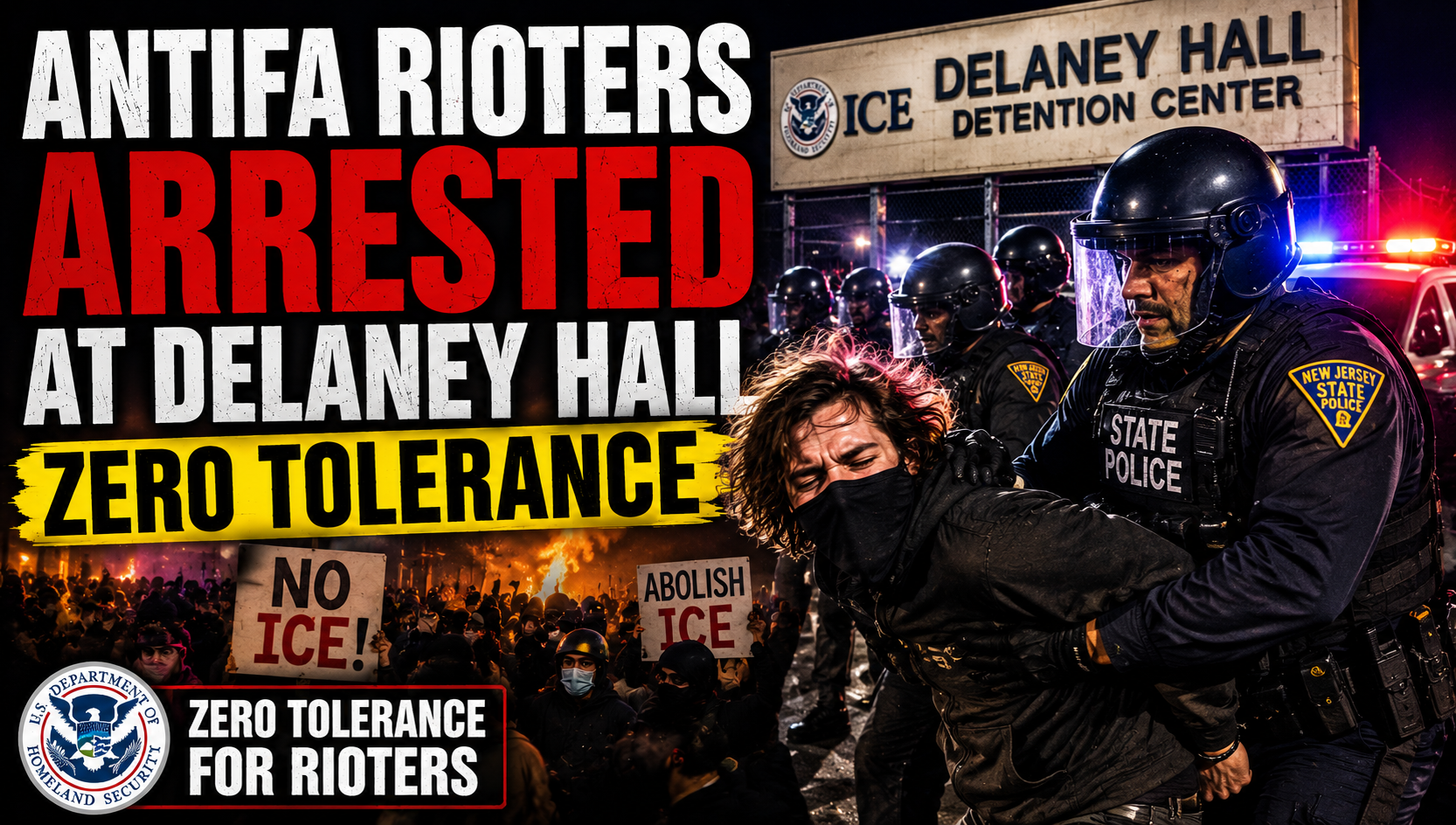
For weeks, anti-ICE activists and Antifa-aligned protesters turned the area around Newark’s Delaney Hall detention center into a spectacle.
Roads were blocked.
Demonstrators clashed with authorities.
Federal immigration officers were harassed.
And activists appeared to believe they could simply outlast law enforcement.
Then reality arrived.
Late Sunday night, New Jersey police moved in and arrested numerous protesters who refused to comply with a newly enforced curfew around the ICE facility. The Department of Homeland Security celebrated the crackdown with a simple message:
“ZERO tolerance for rioters.”
The Protest Movement Hits a Wall
For nearly three weeks, demonstrations outside Delaney Hall had escalated from protests into repeated confrontations with law enforcement. Officials reported arrests, clashes with police, blocked access routes, and protesters equipped with helmets, shields, fireworks, and other gear.
Newark officials eventually imposed a nightly curfew around the detention center, warning that anyone refusing to leave would face enforcement action.
Many protesters apparently assumed those warnings were negotiable.
They weren’t.
As police in riot gear moved into the area Sunday night, arrests quickly followed. DHS footage later showed protesters being detained and loaded onto buses.
An Unusual Political Moment
The most interesting part of the story may be who ultimately enabled the crackdown.
New Jersey Governor Mikie Sherrill has been highly critical of ICE and has publicly opposed the Delaney Hall facility. Yet as tensions escalated, her administration authorized state police involvement to restore order around the detention center.
That created a rare political reality:
Even officials who disagree with federal immigration policy eventually reached the point where maintaining public order became unavoidable.
The lesson is simple.
You can support a cause.
You can protest a policy.
You can disagree with the government.
But once roads are blocked, access is disrupted, and confrontations become routine, the issue stops being free speech and starts becoming public safety.
The Problem for Activists
Many activists have spent years operating under an assumption that enforcement only applies to other people.
Rules apply to businesses.
Rules apply to citizens.
Rules apply to police.
But when activists violate curfews or obstruct operations, enforcement is often portrayed as oppression.
That narrative becomes much harder to sustain when local and state authorities—not just federal agents—decide enough is enough.
The images coming out of Newark told a different story than the one activists wanted to project.
Instead of a triumphant resistance movement, Americans saw protesters being escorted away by police after repeated warnings.
A Reminder About the Rule of Law
Whether someone supports ICE or opposes it, one principle should remain straightforward.
The rule of law cannot function if the loudest group in the street gets to decide which laws are enforced and which are ignored.
Protest is a right.
Rioting is not.
Blocking facilities is not.
Ignoring lawful orders is not.
The events at Delaney Hall may ultimately be remembered for something larger than immigration politics.
They served as a reminder that public order still matters—and that eventually, even the most disruptive activists discover that the law does not stop at the barricades.