

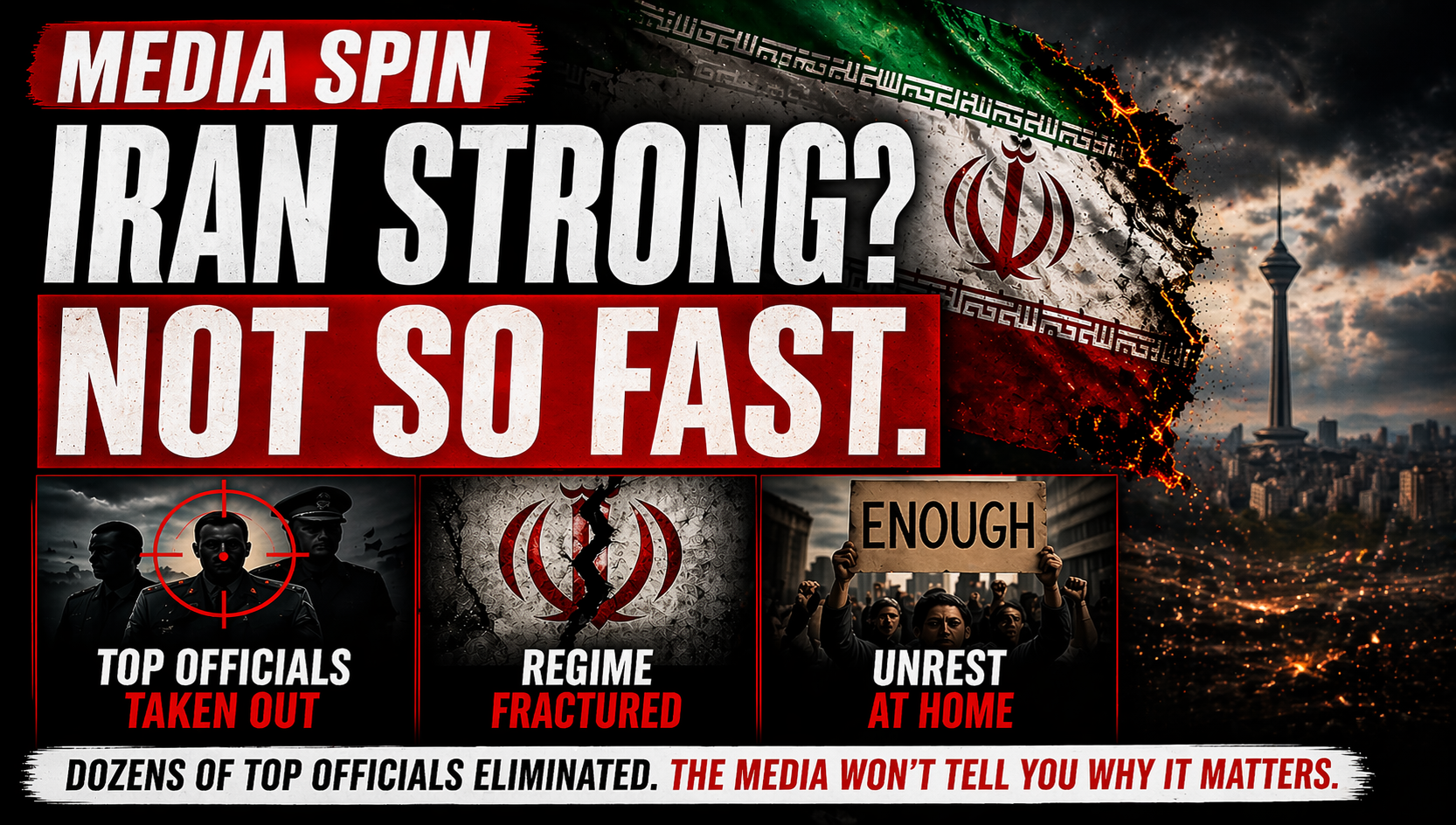
On Monday’s episode of The Alex Marlow Show, Alex Marlow took aim at what he sees as a growing disconnect between headlines and reality in the ongoing Iran conflict.
His argument is simple, but explosive: the media is selling the illusion of strength where there may be weakness.
“What’s going on right now,” Marlow said, “is the media is trying to frame it as though the Iranian regime is actually strong… even after we’ve taken out dozens of top officials.”
That claim cuts directly against a wave of recent reporting that paints a far more complicated picture inside Iran.
A Regime Under Pressure
Behind the scenes, Iran is not exactly projecting unified power.
Recent developments show a fractured leadership structure, especially after the loss of key figures in the chain of command. Analysts say decision-making has become more decentralized, with military factions like the IRGC operating with increasing autonomy and sometimes even contradicting official diplomatic signals.
In fact, Iran has already shown signs of internal division. One day, officials signal openness to negotiation. The next, military forces escalate tensions again, reopening conflict zones like the Strait of Hormuz and undermining their own government’s messaging.
That is not the behavior of a stable, confident regime. It is the behavior of a system under strain.
The “Strength” Narrative
So why the disconnect?
Media framing plays a powerful role in shaping perception. Even when facts are the same, the emphasis can completely change the takeaway.
One outlet highlights Iran’s retaliation and regional reach. Another focuses on leadership losses, internal unrest, and strategic setbacks.
The result is two entirely different stories:
- One where Iran is resilient and dangerous
- Another where Iran is fractured and reactive
Marlow’s criticism is that many mainstream narratives lean toward the former while downplaying the latter.
What the Data Suggests
There is real evidence that Iran has taken significant hits:
- Key leadership figures have been eliminated
- Internal unrest has been growing
- Confidence in the regime’s security has been shaken
Following recent strikes, reports indicate the government has intensified crackdowns at home while grappling with political instability and public dissatisfaction.
At the same time, Iran has shifted toward decentralized command structures, allowing field commanders and proxy groups to act more independently, a move often associated with weakened central control rather than strength.
Strength… or Survival?
None of this means Iran is powerless. It still has regional influence, proxy networks, and the ability to create disruption.
But there’s a difference between strength and survival.
A regime that must:
- Delegate authority to fragmented militias
- Clamp down internally to maintain control
- Send mixed signals between diplomacy and escalation
…is not necessarily winning. It may simply be adapting under pressure.
The Bigger Question
Marlow’s broader point isn’t just about Iran. It’s about perception.
If the public is told a regime is strong, durable, and unshaken, that shapes how people view policy, conflict, and risk.
But if the reality is more fragile, more chaotic, more divided, then the entire narrative changes.
And in modern conflict, narrative is power.
One-line takeaway:
The real battle may not just be on the ground in Iran — it may be over how the story itself is told.