

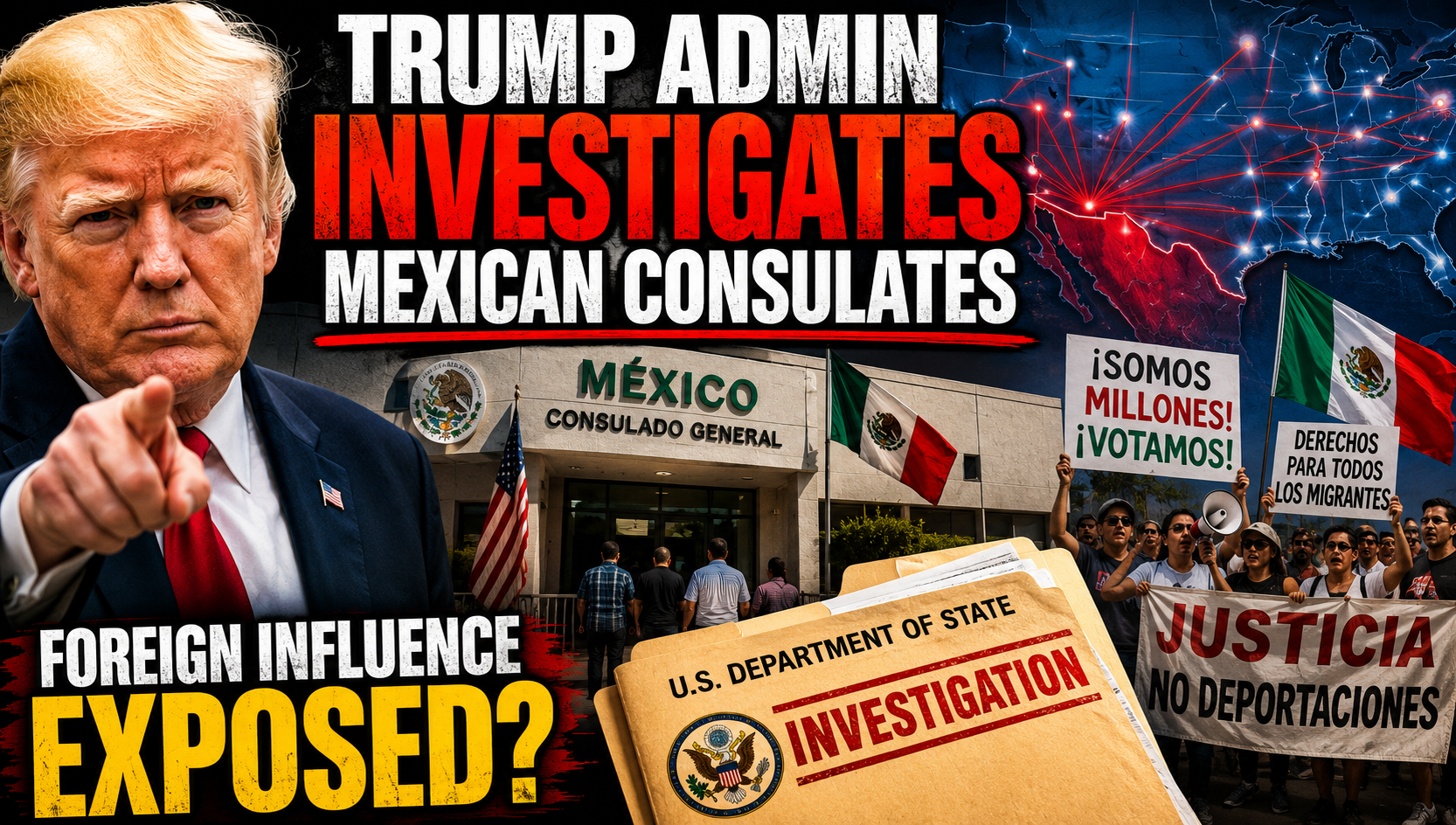
The United States Department of State is reportedly reviewing all 53 Mexican consulates operating across the United States after growing concerns that Mexico’s government may be using its diplomatic network to influence American immigration politics and mobilize migrants inside the U.S.
The review, first reported by CBS News and later expanded upon by the The New York Times, comes as President Donald Trump’s administration moves aggressively to realign foreign policy around national sovereignty, border enforcement, and foreign interference concerns.
At the center of the controversy is author and Breitbart News contributor Peter Schweizer and his book, The Invisible Coup, which argues that foreign governments and American elites have increasingly weaponized immigration to reshape American politics.
According to reports, Schweizer’s recent interview on Breitbart Fight Club’s Founders Roundtable directly caught the attention of officials inside the administration.
Comparing Mexican Consulates to Chinese Espionage Concerns
In the interview cited by the Times, Schweizer questioned why the administration had not yet considered shutting down certain Mexican consulates.
He pointed to the Trump administration’s 2020 closure of the Chinese consulate in Houston, Texas, which federal officials accused of involvement in espionage operations.
“We ordered the Chinese Consulate in Houston closed because of their widespread espionage,” Schweizer said. “So, yes, this is something that’s easily done.”
That comparison immediately escalated the debate from immigration policy to national security.
Critics of Mexico’s diplomatic activity argue the issue is no longer merely about consular assistance for citizens abroad. Instead, they claim Mexican officials have crossed into political activism aimed at influencing American domestic policy.
Allegations of Political Mobilization
In The Invisible Coup, Schweizer alleges that Mexican officials and political figures have actively encouraged migrants in the United States to organize politically against Trump-era border enforcement policies.
The book highlights actions by former Mexican President Andrés Manuel López Obrador, commonly known as AMLO, who reportedly toured American cities in 2017 rallying opposition to Trump’s immigration crackdown.
According to Schweizer, AMLO even proposed transforming Mexican consulates into “migrant defense offices” dedicated to assisting migrants facing deportation or immigration enforcement.
Schweizer argues this crossed a historic line.
“A foreign leader so brazenly interfering in American politics was unprecedented,” he writes.
Supporters of the investigation argue the issue goes beyond humanitarian outreach. They say the concern is whether foreign governments are helping shape political activism inside the United States while benefiting from continued mass migration across the southern border.
Mexico Strongly Denies the Allegations
Mexico’s government has forcefully rejected the accusations.
Claudia Sheinbaum dismissed the claims earlier this year, calling them “absolutely false” and insisting Mexican consulates operate strictly within international law.
According to Sheinbaum, the role of Mexican consulates is simply to provide legal assistance, documentation services, and protection for Mexican nationals living abroad.
“We categorically deny that they are doing anything related to U.S. politics,” she said.
Mexico’s ambassador to the United States, Esteban Moctezuma Barragán, echoed that defense in an interview with CBS News, citing the Vienna Convention governing diplomatic conduct.
“What we do in the United States is what the U.S. does in Mexico,” Moctezuma said, noting that the United States also maintains multiple consulates throughout Mexico.
Why the Story Is Explosive
The issue touches several of the most politically charged debates in America all at once:
- Immigration
- Foreign influence
- Border security
- National sovereignty
- Electoral politics
For Trump supporters, the allegations reinforce long-standing concerns that mass migration is not merely an economic or humanitarian issue, but also a political strategy benefiting both foreign governments and domestic political interests.
For critics, however, the investigation risks inflaming tensions with one of America’s largest trading partners while casting ordinary diplomatic activity as sinister political interference.
Still, the fact that the State Department is reportedly reviewing every Mexican consulate in the country signals that the administration is taking the matter seriously.
And if the investigation uncovers evidence of organized political coordination or advocacy beyond normal consular duties, the consequences could dramatically escalate tensions between Washington and Mexico City.
At minimum, the review represents another sign that the Trump administration is increasingly treating immigration not only as a border issue, but as a matter of foreign influence and national security.