

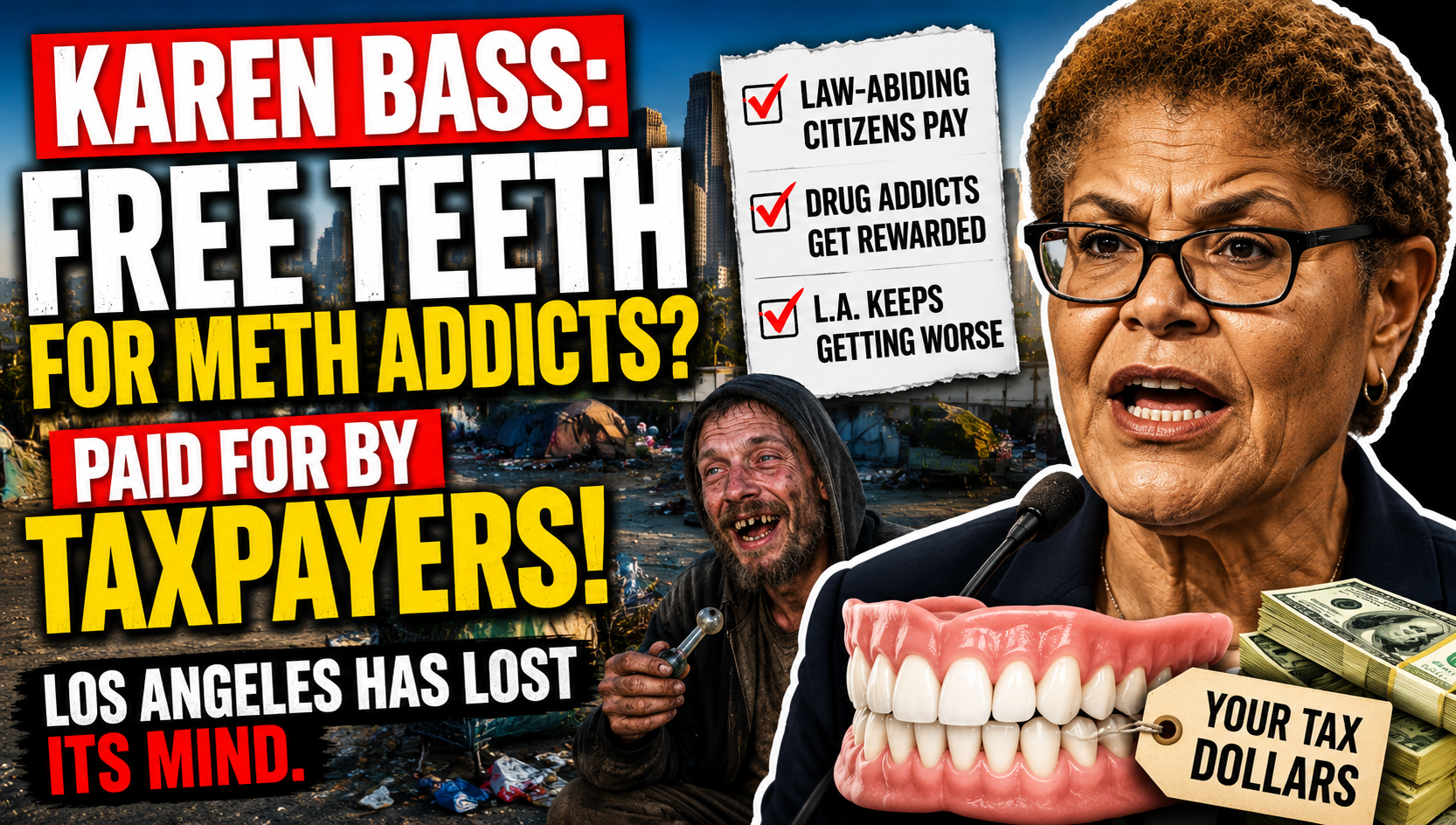
Los Angeles is drowning in crime, homelessness, drug addiction, collapsing infrastructure, and budget disasters. So naturally, Mayor Karen Bass believes the next great government solution is… taxpayer-funded dental work for meth addicts.
Speaking at an event this week, Bass argued that many homeless individuals suffer from severe dental problems because methamphetamine use destroys teeth.
“How many people who are unhoused that you meet have no teeth at all?” Bass asked. “They don’t have teeth, why? Because meth rots your teeth. You can’t succeed without teeth! So there needs to be comprehensive healthcare provided to people.”
That statement perfectly captures modern progressive governance: endlessly treating the symptoms of societal collapse while refusing to confront the behavior causing it.
Los Angeles already spends billions addressing homelessness and addiction. Yet sidewalks remain lined with encampments, businesses continue fleeing the city, and residents increasingly feel abandoned by local leadership. Despite all the spending, the crisis only appears to deepen.
Now Bass wants taxpayers — including working families already crushed by inflation and soaring healthcare costs — to finance extensive dental procedures for chronic drug users.
And we are not talking about a simple cleaning.
Severe meth-related dental destruction often requires extractions, implants, bone grafts, sedation, reconstructive procedures, and long-term follow-up care. Dental implants alone can cost thousands of dollars per tooth. Full-mouth restoration can easily climb into the tens of thousands.
Meanwhile, millions of law-abiding Americans struggle to afford basic dental care for themselves and their children. Medicare still does not comprehensively cover dental care for many seniors who spent decades paying into the system. Countless working people delay procedures because they simply cannot afford them.
But in Los Angeles, political priorities increasingly seem upside down. Citizens who follow the rules are told to wait, sacrifice, and pay more taxes, while government programs increasingly focus on subsidizing the consequences of addiction, crime, and social breakdown.
Critics argue that Bass’s proposal reflects a broader mindset infecting many large American cities: the belief that every social problem can be solved with another taxpayer-funded program, regardless of whether previous programs actually worked.
Los Angeles has already become a cautionary tale of unchecked progressive governance. Once viewed as one of America’s great cities, it now struggles with open-air drug use, collapsing public trust, rampant theft, and a homelessness crisis visible on nearly every major street.
Yet instead of restoring order, enforcing laws, or aggressively targeting addiction itself, city leaders continue floating expensive “harm reduction” policies that many residents believe simply normalize dysfunction.
The deeper frustration for many Americans is not just the cost. It is the message.
People who work hard, obey the law, and pay taxes increasingly feel like they are financing a system that punishes responsibility while rewarding self-destruction. The optics become even worse when politicians use sanitized language like “unhoused” while avoiding blunt discussions about addiction, criminal behavior, and failed policy.
Supporters of Bass’s idea argue that dental care could help recovering addicts rebuild their lives and improve employability. There is some truth to that. Serious addiction recovery often requires addressing physical and mental health together.
But critics counter that rebuilding a functioning society requires more than cosmetic restoration programs. They argue cities must first restore public order, enforce laws consistently, and stop incentivizing permanent dependency.
That debate is becoming increasingly central not just in Los Angeles, but across America.
Because for many voters, the question is no longer whether progressive cities are spending enough money.
It is whether they are spending it on the wrong people entirely.