

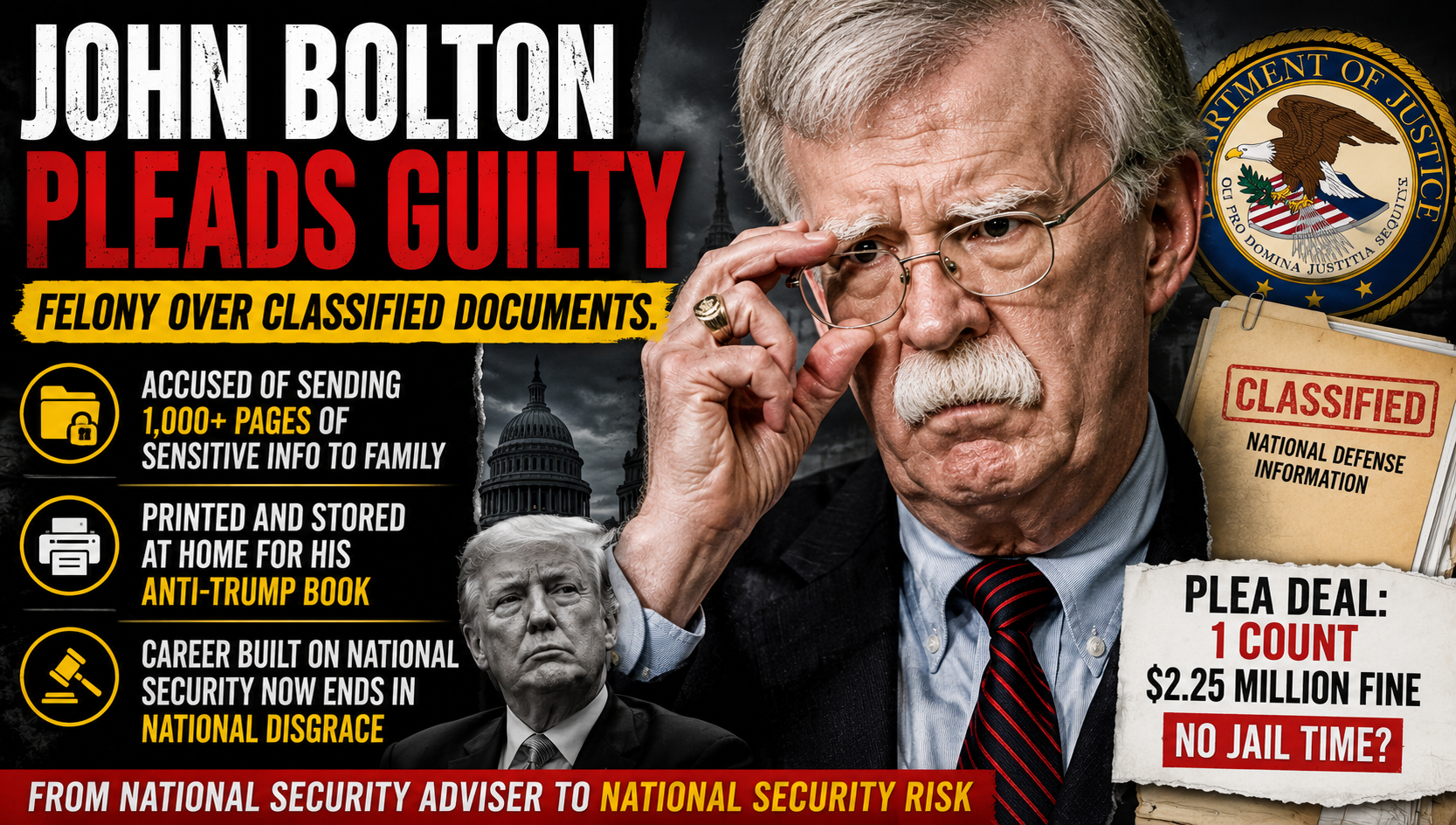
For decades, John Bolton built his reputation as one of Washington’s most aggressive national security hawks.
Now, according to reports, the former National Security Adviser is preparing to plead guilty to a felony involving the handling of sensitive national security documents.
The development marks a remarkable downfall for a man who spent much of his career warning about threats to American security while advocating a hardline foreign policy around the globe.
From Hawk to Defendant
According to reports, Bolton has reached a plea agreement with federal prosecutors that would reduce a far more serious case down to a single count of illegally retaining sensitive national security documents.
The original indictment reportedly included 18 separate counts involving the transmission and retention of national defense information.
Had prosecutors secured convictions on all counts, Bolton could have faced significant prison time.
Instead, the reported agreement would require Bolton to plead guilty to one felony count and pay a $2.25 million fine.
While the deal reportedly does not include jail time, the presiding judge would still have authority to impose a prison sentence.
The Allegations
Federal prosecutors alleged that Bolton improperly retained and transmitted more than 1,000 pages of classified or sensitive national security material.
According to court filings, some of the information was allegedly sent electronically to family members and later printed and stored at Bolton’s residence.
Prosecutors argued that the material was connected to Bolton’s efforts to write and publish a memoir following his departure from the Trump administration.
If true, the allegations paint a striking picture: one of Washington’s most vocal national security advocates accused of mishandling the very information he spent years insisting must be protected.
A Bitter Break With Trump
Bolton served as National Security Adviser during President Donald Trump’s first administration, but the relationship quickly deteriorated.
What began as a high-profile appointment evolved into one of the most public feuds of the Trump era.
After leaving the White House, Bolton became one of Trump’s most prominent Republican critics, publishing a memoir that detailed internal disagreements and sharply criticized the administration.
Trump responded with repeated attacks on Bolton, describing him as incompetent, disloyal, and motivated by personal ambition.
The hostility between the two men never subsided.
The Irony
Politics aside, the allegations create an obvious contradiction that critics have seized upon.
Bolton’s public image was built around a simple message: America faces dangerous enemies, and national security must be taken seriously.
Whether discussing Iran, North Korea, China, Russia, or terrorism, Bolton consistently argued that protecting sensitive information and maintaining American strength were paramount responsibilities.
That is why the allegations strike many observers as particularly damaging.
The man who built a career demanding strict accountability on national security issues now finds himself accused of violating those same standards.
A Career Defined by Controversy
Even before these charges, Bolton was one of the most polarizing figures in Washington.
Supporters viewed him as a principled defender of American interests who refused to compromise with hostile regimes.
Critics saw him as an interventionist whose foreign policy prescriptions often pushed the United States toward unnecessary conflicts.
Now another chapter is being added to that legacy.
If the reported plea agreement moves forward, Bolton’s long career in government may ultimately be remembered less for the battles he wanted America to fight overseas and more for the legal battle that ended his own public life.
For a man who spent decades presenting himself as a guardian of national security, pleading guilty to mishandling sensitive national defense information would be a dramatic and deeply symbolic final act.