

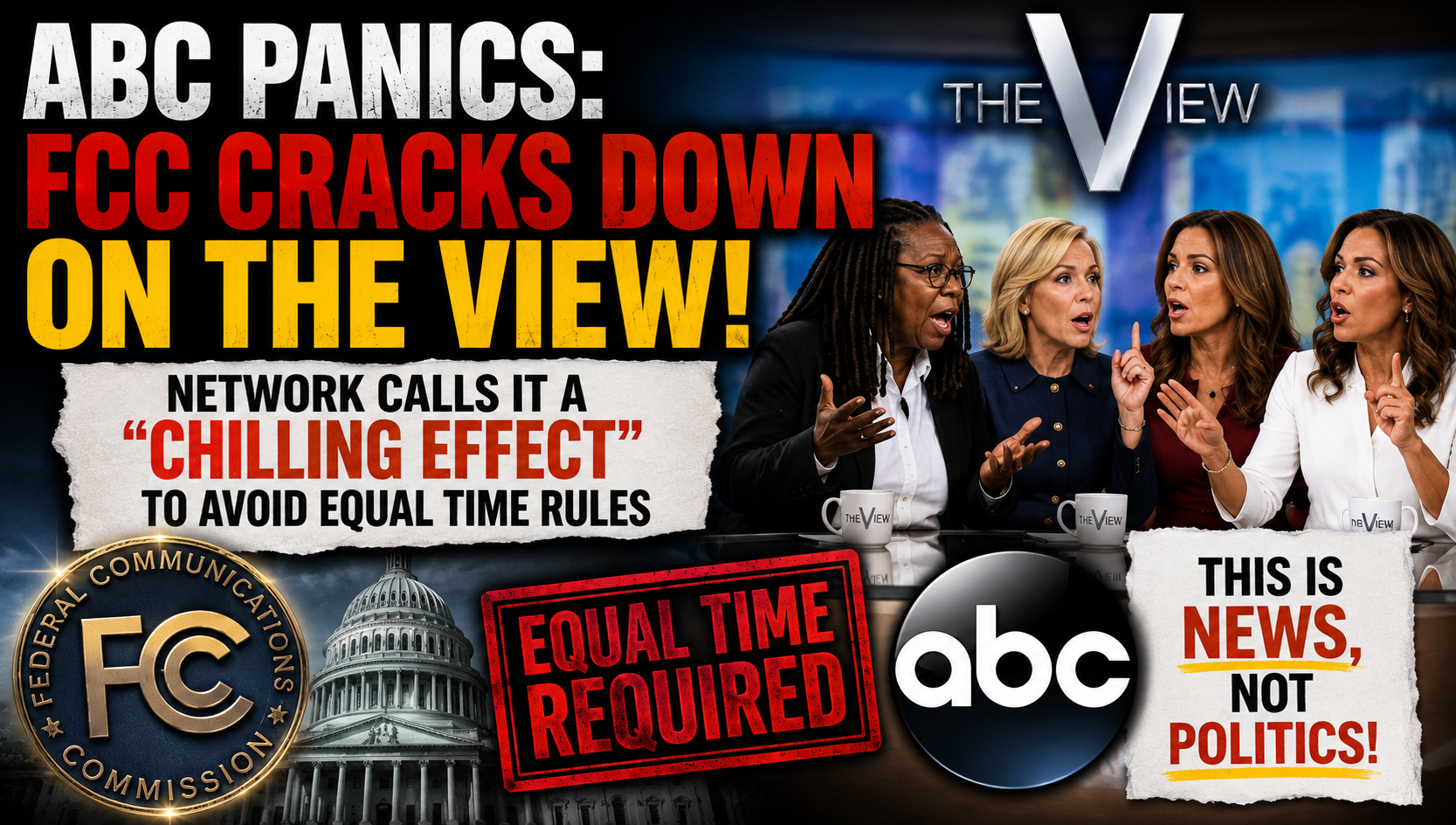
A growing battle between major broadcast networks and the Federal Communications Commission is rapidly escalating after ABC accused the agency of trying to silence political speech by questioning whether The View qualifies as a legitimate news program.
At the center of the fight is a deceptively simple question with enormous consequences:
Is The View actually news — or is it political entertainment using public airwaves to push partisan messaging?
ABC says the answer is obvious.
Critics say the answer exposes decades of media double standards.
ABC Claims FCC Is Creating a “Chilling Effect”
In a filing submitted Friday, ABC argued that the FCC’s actions threaten protected speech and could overturn decades of precedent involving broadcast media exemptions.
The network defended The View as a “bona fide” news interview program, a classification that gives broadcasters more flexibility under federal equal-time rules for political candidates.
ABC argued the show has operated under that exemption for more than twenty years without issue.
“The Commission’s actions threaten to upend decades of settled law and practice and chill critical protected speech,” the network wrote.
But opponents argue the real issue is not censorship.
They argue it is accountability.
Critics: “This Isn’t News — It’s a Partisan Circus”
The FCC review comes as Chairman Brendan Carr pushes broadcasters to comply more strictly with equal-time laws designed to prevent networks from giving unfair advantages to political candidates.
Those rules require broadcast networks using public airwaves to provide balanced opportunities to opposing candidates when political figures appear on programs outside legitimate news coverage.
That is where critics say The View has a problem.
Center for American Rights President Daniel Suhr blasted the program, arguing that its overwhelming imbalance of Democrat-to-Republican guests destroys any serious claim that it operates as neutral journalism.
“It is not a news program,” Suhr said. “It is a partisan circus.”
According to Suhr, appearances by politicians on programs like The View increasingly resemble free campaign advertising disguised as daytime television.
And that distinction matters because broadcast television still operates under federal public-interest obligations.
Even Media Allies Admit the Legal Questions Are Real
What makes the controversy especially explosive is that criticism is not only coming from conservatives.
Even some longtime left-leaning media policy figures acknowledge the legal concerns are legitimate.
Gigi Sohn, former FCC advisor and cofounder of Public Knowledge, admitted that entertainment programs receiving “bona fide news” exemptions has long been controversial.
Sohn argued that if entertainment programs can effectively provide candidates with free campaign exposure while avoiding equal-time requirements, the law itself becomes meaningless.
That admission weakens claims that the FCC inquiry is simply political retaliation.
Instead, the debate is increasingly becoming about whether modern media companies have stretched “news exemptions” far beyond what Congress originally intended.
The Bigger Question: News or Activism?
The controversy also exposes a larger cultural shift happening throughout American media.
For decades, networks blurred the lines between journalism, activism, comedy, and entertainment while still demanding the legal protections traditionally reserved for objective news organizations.
Programs like The Late Show with Stephen Colbert, Jimmy Kimmel Live!, and The View increasingly function as political commentary platforms with heavily ideological audiences.
Critics argue these shows openly campaign for favored candidates while shielding themselves behind outdated regulatory classifications written for a completely different media era.
Supporters counter that the FCC’s actions risk allowing the government to police political speech and determine what qualifies as “real journalism.”
That is where the fight becomes dangerous.
Because once government agencies begin deciding which speech is sufficiently neutral, every media organization becomes vulnerable to political pressure.
Why the Stakes Are So High
This battle is about far more than The View.
If the FCC aggressively enforces equal-time standards against entertainment and talk programs, the decision could fundamentally reshape political broadcasting in America.
Late-night television, celebrity interviews, daytime talk shows, comedy programs, and even podcast simulcasts on broadcast networks could face new scrutiny.
Networks may ultimately have to choose between two uncomfortable options:
Either operate as genuine neutral news platforms — or openly admit they are partisan entertainment.
For years, many critics have argued broadcasters wanted both protections at once.
Now, the FCC appears ready to test whether that arrangement can survive much longer.