

For years, the public has been warned that artificial intelligence is coming for their jobs.
Factory workers. Writers. Programmers. Accountants. Teachers.
The fear is simple: as machines become smarter, humans become unnecessary.
But Amazon founder Jeff Bezos says that prediction has it exactly backward.
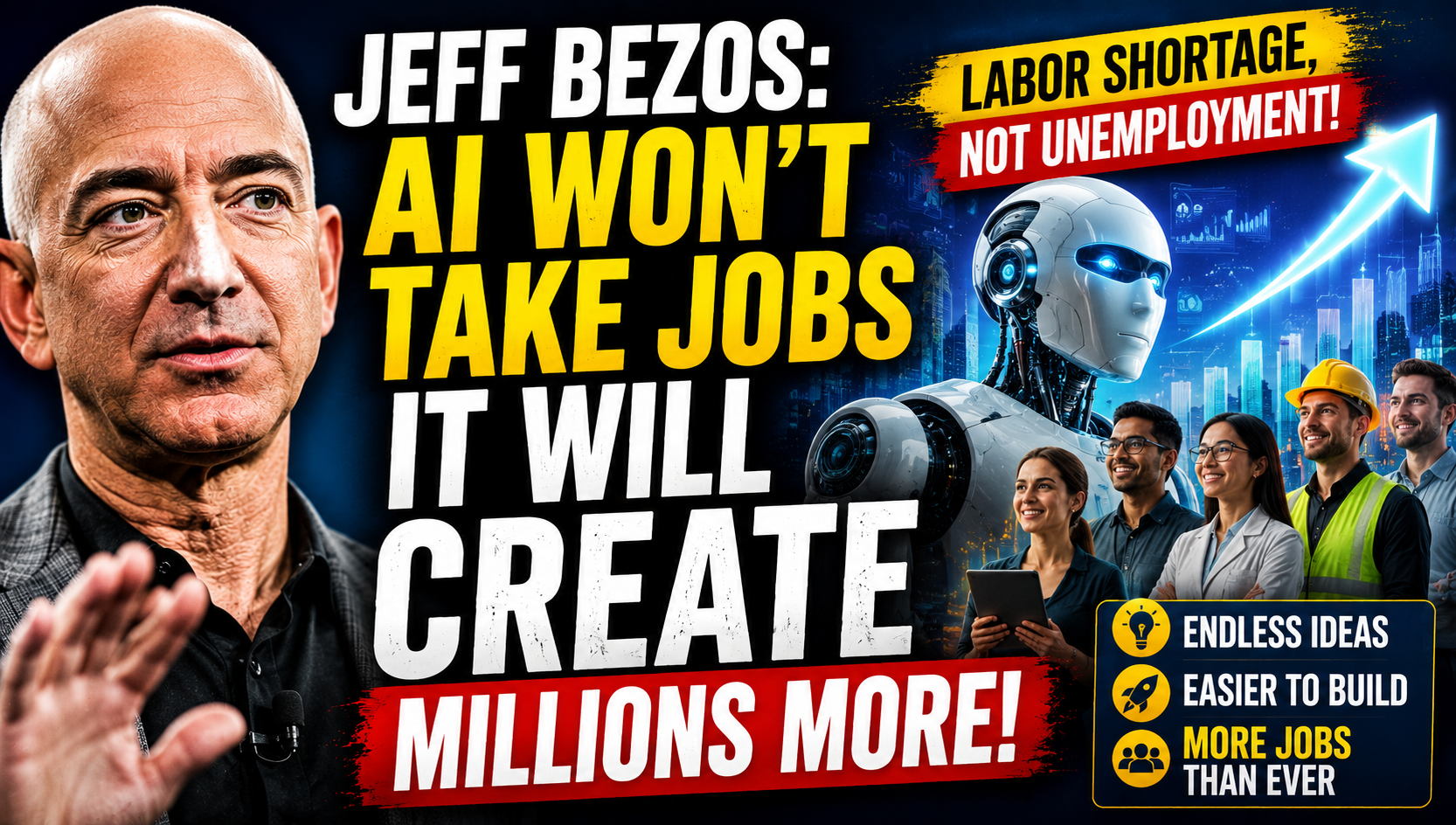
Speaking at the VivaTech conference in Paris, Bezos argued that AI won’t create mass unemployment. Instead, he believes it will create a labor shortage.
That may sound absurd at first. After all, every week seems to bring another headline about AI replacing workers or automating tasks once performed by people.
Yet Bezos sees a different problem.
According to him, humanity isn’t running out of work. It’s running out of capacity.
“We have an endless set of things to invent,” Bezos said. The real bottleneck isn’t imagination. It’s execution.
Think about how many business ideas never leave the napkin stage. How many inventions never get built. How many products, services, and technologies never see the light of day because turning an idea into reality is expensive, difficult, and time-consuming.
Bezos believes AI changes that equation.
If artificial intelligence dramatically lowers the cost of creation, millions of ideas that were previously impossible suddenly become viable. Entrepreneurs will launch companies faster. Inventors will build products quicker. Researchers will solve problems more efficiently.
Instead of eliminating work, AI could unleash an explosion of new work.
In Bezos’s view, the future isn’t a world where humans sit idle while machines do everything. It’s a world where so many new opportunities emerge that businesses struggle to find enough people to pursue them.
That outlook puts him at odds with many technology leaders who warn that AI could displace millions of workers.
And the public remains skeptical.
Polls consistently show Americans are deeply concerned about artificial intelligence replacing jobs, disrupting industries, and reshaping society faster than people can adapt.
Those fears aren’t irrational. AI is already changing the way companies hire, write code, create content, analyze data, and handle customer service.
But Bezos argues that history offers a different lesson.
Previous technological revolutions didn’t eliminate human labor. They transformed it.
The automobile didn’t end employment. It created entirely new industries.
The internet didn’t eliminate jobs. It created millions that didn’t previously exist.
AI, Bezos believes, could be the next chapter in that story.
His vision extends even further.
Bezos suggested that advanced AI could accelerate breakthroughs in space exploration, making it cheaper and more reliable to access resources from asteroids, the moon, and other celestial bodies. In his most ambitious scenario, humanity could eventually move heavy industry off Earth altogether, preserving the planet while expanding economic growth beyond it.
Whether that future arrives remains to be seen.
What is clear is that the debate over AI is far from settled.
Some see a coming employment apocalypse.
Others see the greatest productivity boom in human history.
Jeff Bezos has planted his flag firmly in the second camp.
And if he’s right, the biggest challenge of the AI age may not be finding work.
It may be finding enough workers.