

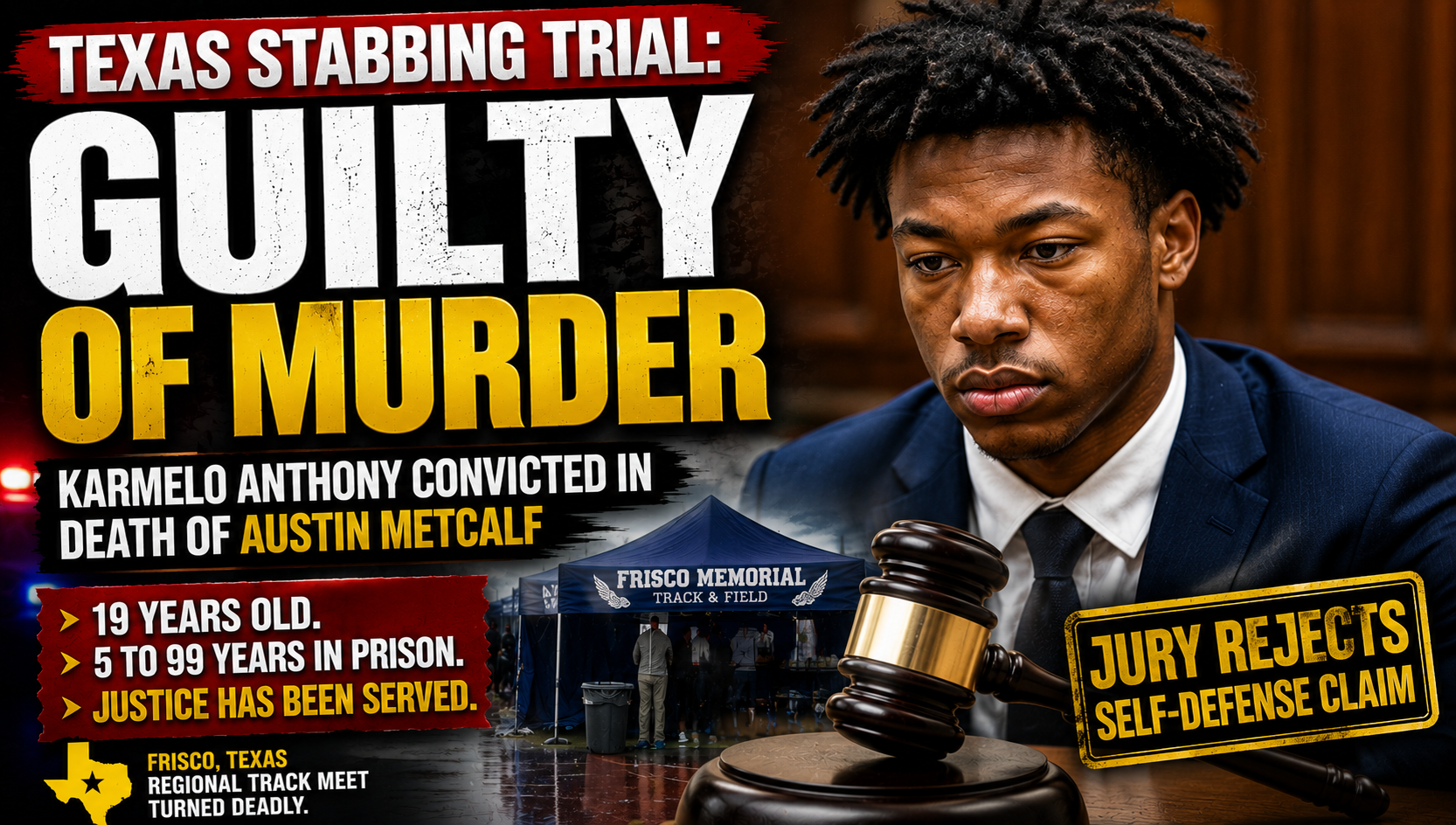
A Texas jury took just three hours to reach a verdict that could send 19-year-old Karmelo Anthony to prison for decades.
Anthony was found guilty of murder in the fatal stabbing of 17-year-old Austin Metcalf during a regional track meet in Frisco, Texas, bringing one of the year’s most closely watched criminal cases to a dramatic conclusion.
The case centered on a deadly confrontation inside a tent used by student-athletes during a rain delay. Witnesses testified that Anthony, who was not a student at Frisco Memorial High School, had entered the team’s tent and was repeatedly asked to leave. According to testimony, athletes told him to go elsewhere numerous times before tensions escalated.
The defense argued that Anthony acted in self-defense after being confronted by Austin Metcalf and his twin brother Hunter. Attorneys claimed Anthony feared for his safety and was forced to defend himself.
The jury wasn’t convinced.
Multiple witnesses testified that they never saw the Metcalf brothers gang up on Anthony. One student-athlete delivered some of the most damaging testimony for the defense, telling jurors that Anthony kept his hands in his backpack until Metcalf shoved him and then responded by pulling a knife and stabbing the teen in the chest.
“That’s lethal force against non-lethal,” the witness reportedly told the court.
The prosecution’s case was further strengthened when several witnesses challenged the self-defense narrative. Even testimony presented by the defense appeared to undercut Anthony’s claims, with one defense witness reportedly acknowledging that Anthony was responsible for escalating the encounter.
Perhaps most surprising was the defense’s decision not to put Anthony on the witness stand.
In a case built around self-defense, jurors never heard directly from the man accused of the killing. Legal analysts have long noted that defendants claiming self-defense often benefit from explaining their actions and state of mind to a jury. Anthony’s attorneys chose a different strategy, and the gamble appears to have failed.
The racial dynamics of the case also drew national attention. Anthony is black and Metcalf was white, leading some activists and commentators to frame the case through a racial lens. But inside the courtroom, jurors appeared focused on the facts presented. Several key witnesses whose testimony supported the prosecution’s case were themselves black, making it more difficult for the defense to argue that race played a role in the accusations against Anthony.
Before deliberations began, jurors were instructed that they could consider manslaughter as a lesser charge. Nevertheless, they rejected that option and returned a murder conviction.
The speed of the verdict speaks volumes.
After weeks of testimony, jurors needed only a few hours to conclude that Anthony’s actions met the legal standard for murder.
Now the case enters its next phase.
Under Texas law, Anthony faces a sentence ranging from five to 99 years in prison. Because he was under 18 at the time of the offense, he is not eligible for the death penalty.
According to reporters in the courtroom, Anthony appeared emotional as the verdict was read, shaking and crying as jurors announced their decision. His mother reportedly took the stand during sentencing proceedings and asked jurors to show mercy to her son.
For the Metcalf family, however, the verdict marks the end of a long legal battle and the beginning of a different kind of struggle. Nothing can bring back Austin Metcalf, a 17-year-old whose life ended over a confrontation that witnesses say never should have turned deadly.
The jury has now spoken. The only question remaining is how many years Anthony will spend behind bars.