

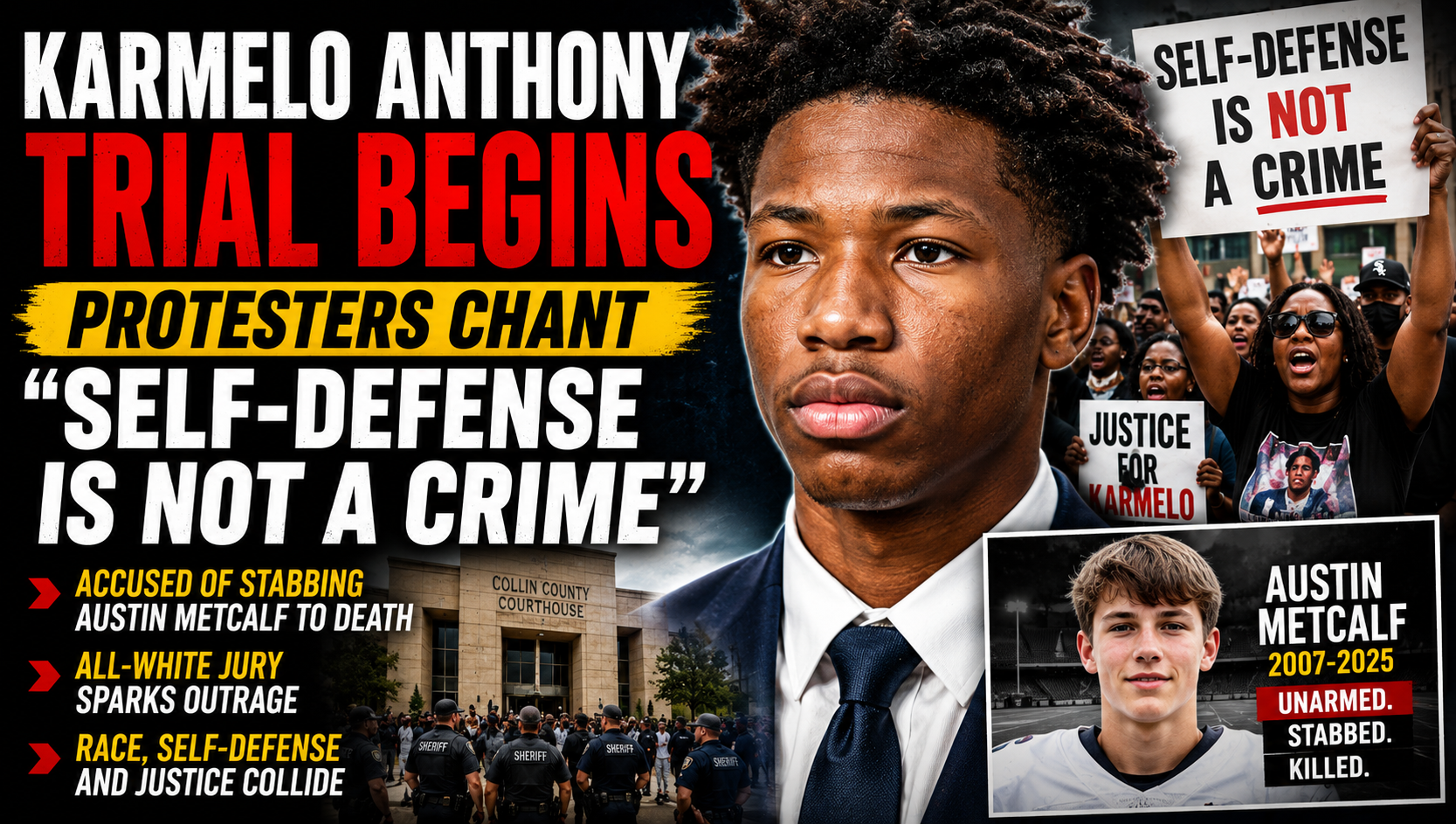
As jury selection concluded and opening arguments began in the murder trial of Karmelo Anthony, demonstrators gathered outside a Texas courthouse to support the teenager accused of fatally stabbing fellow student Austin Metcalf during a confrontation at a high school track meet.
The case has already generated intense national attention. Now the protests surrounding the trial are adding another layer of controversy.
Supporters of Anthony have been filmed chanting “self-defense is not a crime,” echoing the central argument expected from the defense team as the trial moves forward.
Anthony, now 19, is accused of killing 17-year-old Austin Metcalf during an altercation at a Frisco, Texas high school event in April 2025. Prosecutors allege that Anthony pulled a knife from his bag and stabbed the unarmed football player in the chest during an argument.
The defense has maintained that Anthony acted in self-defense.
Tensions Rise Outside the Courthouse
The demonstrations quickly became confrontational.
Videos circulating online appear to show heated exchanges between Anthony supporters and counter-protesters. Other clips show protesters shouting insults and racial slurs at those on the opposite side of the case.
The scenes highlight how the trial has evolved beyond a criminal proceeding into a flashpoint for broader debates over race, self-defense laws, and media coverage.
What might have once been viewed as a tragic dispute between two teenagers has increasingly become a national political and cultural battleground.
Jury Controversy Sparks New Debate
Another point of contention emerged during jury selection.
The final jury seated in the case contains no black jurors, prompting objections from Anthony’s legal team.
Defense attorneys argued that three black prospective jurors were removed improperly by prosecutors. Prosecutors responded that the individuals were excluded because all three worked as schoolteachers and the case centers on events that occurred at a school.
The judge ultimately accepted the prosecution’s explanation and allowed the jury to be empaneled.
The dispute has already fueled accusations of racial bias from activists supporting Anthony, while others argue that the prosecution’s reasoning was both lawful and routine.
A Case Larger Than the Courtroom
The sharp divide visible outside the courthouse reflects a broader trend in high-profile criminal cases.
Before evidence has been fully presented, large segments of the public have already chosen sides.
To Anthony’s supporters, the case represents questions about self-defense and racial fairness.
To supporters of the Metcalf family, the facts appear much simpler: an unarmed teenager was killed during a dispute, and the person accused of doing it must answer for that act in court.
The jury now faces the task that social media has largely abandoned: weighing the evidence rather than the slogans.
Over the coming weeks, testimony, forensic evidence, witness accounts, and legal arguments will determine whether Anthony’s claim of self-defense holds up under scrutiny.
Until then, the crowds outside the courthouse are a reminder that in modern America, some trials begin long before the jury ever enters the room.