

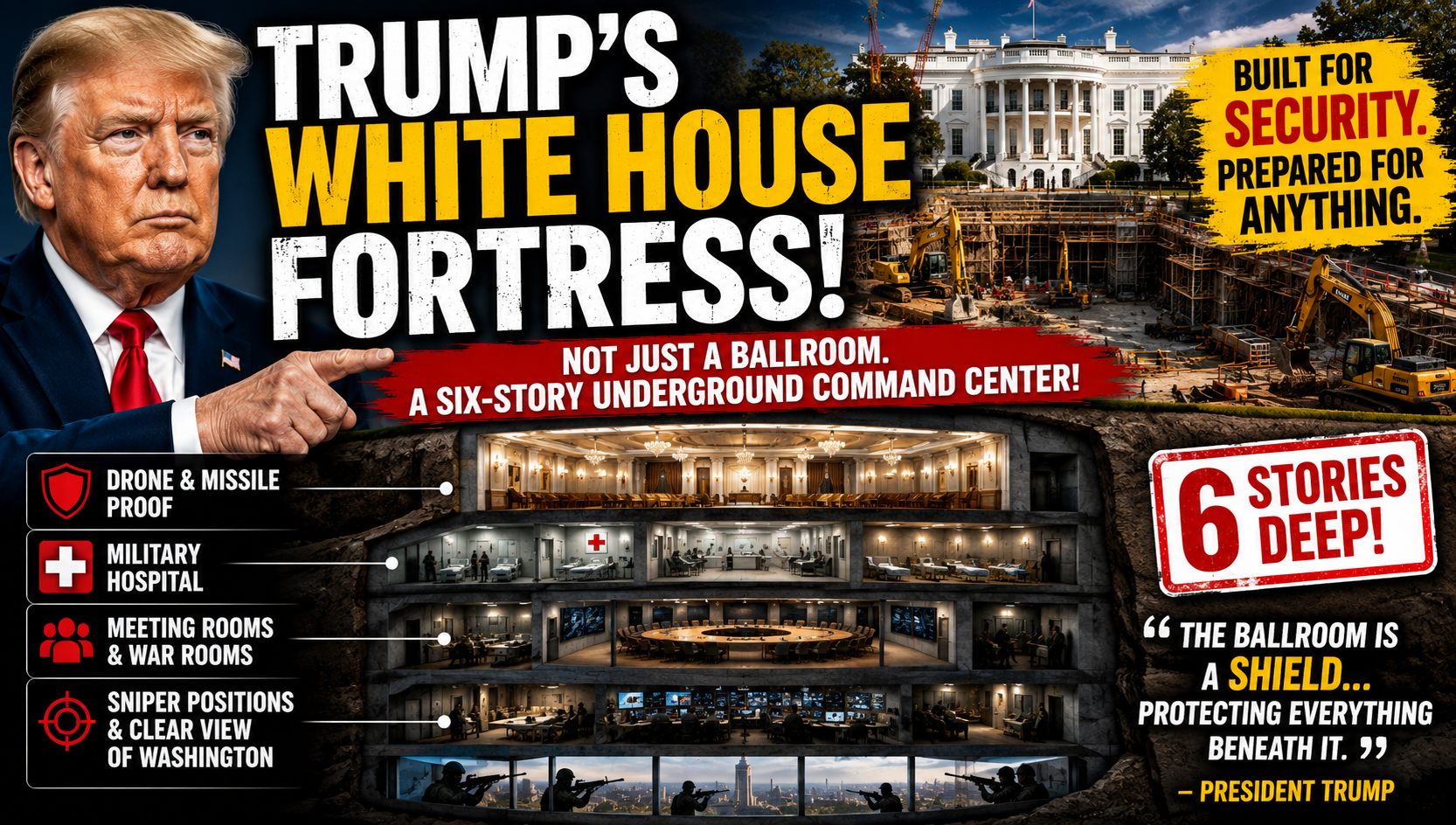
What began publicly as a plan for a grand White House ballroom is now sounding far more like a fortified underground command complex.
Standing outside the massive construction site on Tuesday, President Donald Trump revealed that the project extends far beyond elegant entertaining space. Beneath the ballroom, Trump says crews are building a sprawling underground facility complete with a military hospital, research facilities, meeting rooms, sniper positions, and hardened defensive infrastructure designed to withstand modern threats ranging from drones to missile attacks.
And according to Trump, much of it stretches six stories underground.
“The Ballroom Is Really a Shield”
Trump described the visible ballroom portion almost as camouflage for what is actually being constructed below.
“These are all different rooms out here,” Trump told reporters while touring the site. “They’re building a hospital. They’re building a military hospital. They’re building all sorts of research facilities.”
He added that the ballroom itself serves as a kind of protective layer covering the deeper complex beneath it.
“The ballroom is really a shield and protecting all of the things that are built here,” Trump explained.
That language immediately caught attention because this no longer sounds like a traditional White House renovation project. It sounds like the construction of a hardened continuity-of-government facility embedded directly into the White House grounds.
Trump also emphasized the defensive capabilities built into the design.
“It’s all knit together between the drone proofing [and] the missile proofing,” he said.
Then came perhaps the most striking line of the tour:
“I hate to use the word snipers, but we have great sniper capacity.”
Trump clarified that the structure is “built for our snipers, not the enemy snipers,” adding that the elevated positioning provides clear sightlines “all over Washington.”
The White House Is Adapting to a More Dangerous Era
While critics immediately mocked the project as excessive or theatrical, the reality is that the White House has increasingly become a target in an age of drones, political extremism, asymmetric warfare, and assassination threats.
The attempted attack connected to the recent White House Correspondents’ Dinner appears to have intensified concerns surrounding presidential security and continuity planning.
Following that foiled incident, Trump argued that the secure ballroom and underground facilities are exactly the kind of infrastructure presidents should have demanded decades ago.
“What happened last night is exactly the reason that our great Military, Secret Service, Law Enforcement and, for different reasons, every President for the last 150 years, have been DEMANDING that a large, safe, and secure Ballroom be built ON THE GROUNDS OF THE WHITE HOUSE,” Trump wrote afterward.
Whether one agrees with Trump politically or not, the broader point reflects a real shift in modern security realities.
The White House was originally designed in the eighteenth century.
Modern threats are twenty-first century.
Drones, precision-guided munitions, cyberwarfare, and lone-wolf assassination attempts have dramatically altered what presidential security now requires.
A White House That Barely Resembles the Original
Ironically, critics portraying this project as some unprecedented transformation ignore the fact that the modern White House already bears little resemblance to the structure first occupied by President John Adams.
Over two centuries, the White House has been rebuilt, expanded, burned, renovated, reinforced, modernized, and repeatedly altered by nearly every administration.
The underground bunkers and continuity facilities already existing beneath the White House have long been part of presidential security planning, especially since the Cold War.
Trump’s project simply appears to be expanding that philosophy into a far larger and more integrated system.
The Senate Fight Adds More Drama
The project has also become a political flashpoint in Washington.
A Senate parliamentarian ruling recently blocked part of a Republican effort to secure roughly $1 billion in funding for the ballroom and associated infrastructure through the reconciliation process.
Democrats celebrated the setback, while Republicans insist they are already working on procedural fixes.
Meanwhile, reports indicate Trump has privately urged Senate Majority Leader John Thune to remove Senate Parliamentarian Elizabeth MacDonough over the ruling.
The political battle, however, may ultimately be secondary to what this construction symbolizes.
America’s Government Is Preparing for Instability
Perhaps the most revealing aspect of the project is psychological.
Governments do not spend billions hardening facilities against drones, missile attacks, sniper threats, and continuity crises unless they genuinely believe such scenarios are increasingly plausible.
Trump’s underground White House expansion reflects a broader reality quietly reshaping governments worldwide:
Leaders increasingly expect instability.
Not merely protests or political turbulence.
But serious threats involving terrorism, drone warfare, infrastructure attacks, cyber conflict, and internal unrest.
The modern presidency now operates in an era where threats once associated only with war zones are becoming normalized within Western capitals themselves.
And beneath the White House lawn, America appears to be preparing accordingly.