

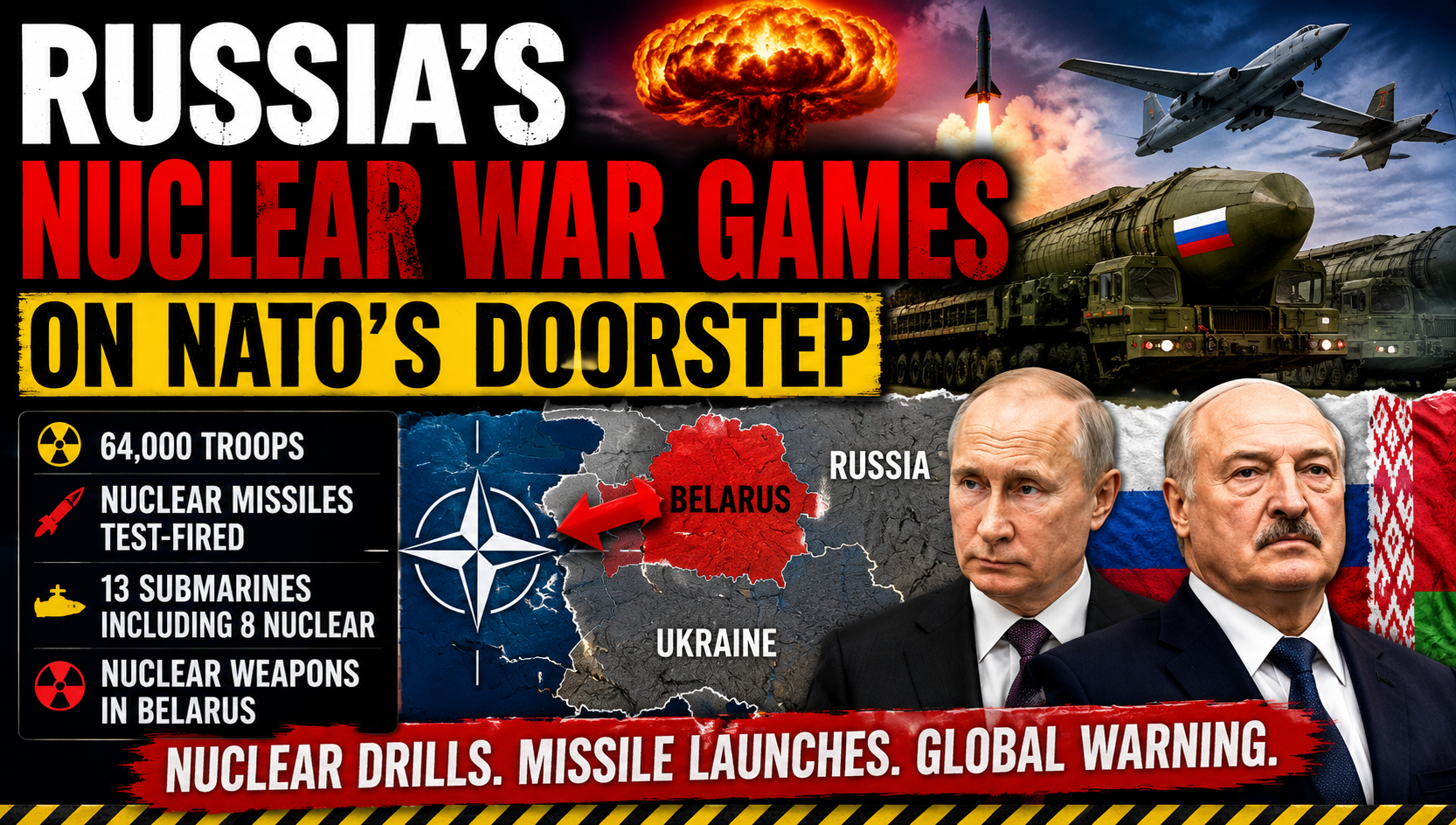
Russia has launched one of its largest nuclear preparedness exercises since the invasion of Ukraine, mobilizing tens of thousands of troops, nuclear-capable missile systems, submarines, bombers, and warships in a sweeping show of force alongside neighboring Belarus.
The message from Moscow is unmistakable: Russia wants the world thinking about nuclear war again.
According to Russian state media, the two-day drills involve roughly 64,000 troops, nearly 8,000 weapons systems, over 140 aircraft, 73 naval vessels, 13 submarines, and multiple branches of Russia’s strategic nuclear forces. The exercises reportedly include ballistic and cruise missile test launches, strategic bomber operations, and coordination between Russian and Belarusian forces surrounding the deployment of tactical nuclear weapons stationed inside Belarus.
The Kremlin claims the operation is merely defensive and intended to prepare for an “aggression threat.” But few observers are treating this as routine military housekeeping.
Russia’s Nuclear Shadow Expands Into Belarus
The most alarming aspect of the exercises is the continued integration of Belarus into Russia’s nuclear posture.
For nearly three decades after the collapse of the Soviet Union, Belarus remained nuclear-free. That changed in 2023 when Moscow began deploying tactical nuclear weapons onto Belarusian territory for the first time since the Cold War.
Now, Russian and Belarusian forces are openly rehearsing the logistical deployment and operational use of those weapons.
That matters enormously because Belarus sits directly on NATO’s doorstep, bordering Poland, Lithuania, and Latvia while also sharing a long border with Ukraine. During Russia’s initial 2022 invasion, Belarus served as a launchpad for Russian offensives toward Kyiv.
Ukraine’s government condemned the drills as a direct threat to global security and accused Moscow of turning Belarus into a “nuclear bridgehead” near NATO territory.
The concern is not merely symbolic.
Analysts believe the weapons stationed in Belarus include nuclear warheads for Iskander missile systems as well as aircraft-delivered tactical nuclear bombs capable of striking targets hundreds of miles away.
Putin Keeps Raising the Nuclear Temperature
Since the beginning of the Ukraine war, Russian President Vladimir Putin has repeatedly invoked Russia’s nuclear arsenal as both deterrent and warning.
Every major escalation in the war has been accompanied by increasingly aggressive nuclear rhetoric from Moscow.
In 2023, Putin suspended Russia’s participation in the New START nuclear arms treaty, ending inspections and transparency measures that had helped stabilize U.S.-Russian nuclear relations for years. Later that same year, Moscow withdrew entirely from the Comprehensive Nuclear-Test-Ban Treaty.
Then in 2024, Putin escalated further by warning that attacks by a non-nuclear country supported by a nuclear power could now be treated as a “joint attack” under Russia’s nuclear doctrine.
The implication was clear: if Ukraine uses Western weapons to strike deep into Russian territory, Moscow could theoretically justify a nuclear response.
Now, with large-scale nuclear drills unfolding across Russia and Belarus, those warnings suddenly feel far less abstract.
A Return to Cold War Fear
For years after the collapse of the Soviet Union, much of the West treated nuclear confrontation as a fading relic of the twentieth century.
That illusion is rapidly disappearing.
The Russia-Ukraine conflict has revived fears many assumed had vanished permanently: tactical nuclear escalation, miscalculation between nuclear powers, regional proxy wars spiraling into global conflict, and the collapse of arms-control frameworks that once restrained superpower tensions.
The scale of these exercises suggests Moscow wants NATO leaders, Ukraine, and the broader international community constantly aware of Russia’s nuclear capabilities hovering in the background of the war.
This is psychological warfare as much as military preparation.
Putin understands that nuclear fear remains one of the few tools capable of rattling Western publics and pressuring cautious political leaders.
The World Is Entering Dangerous Territory
The danger is not necessarily that Russia intends to launch nuclear weapons tomorrow.
The danger is normalization.
Each new nuclear threat.
Each treaty withdrawal.
Each strategic drill.
Each public rehearsal of escalation.
All of it slowly shifts the boundaries of what the world considers possible.
During the Cold War, nuclear deterrence relied heavily on predictability, communication, and clearly understood boundaries. Those boundaries are becoming increasingly blurred.
Today’s geopolitical landscape is far more unstable:
- Proxy wars are expanding.
- NATO and Russia are operating closer to direct confrontation.
- China is rapidly expanding its nuclear arsenal.
- Iran’s nuclear ambitions continue to grow.
- Arms-control agreements are collapsing one by one.
Against that backdrop, Russia’s massive nuclear exercises are not just another military story.
They are a warning that the post-Cold War era may truly be over.