

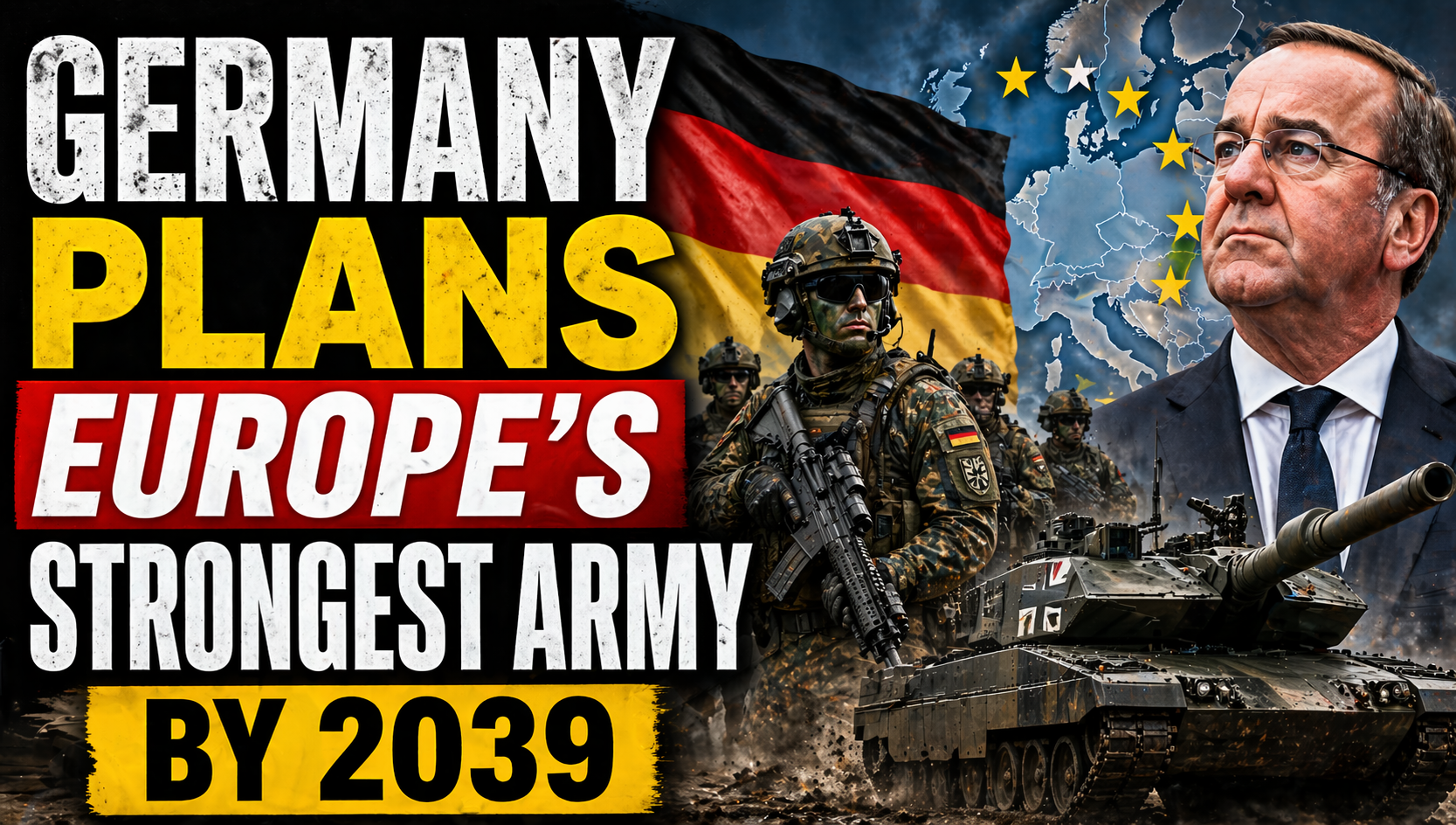
Germany just dropped a message to the world — and it’s not subtle.
In a sweeping new military strategy, Berlin is aiming to transform the Bundeswehr into the most powerful conventional army in Europe by 2039. That’s not just a policy tweak. That’s a generational pivot.
And it raises a bigger question: What does Germany see coming that requires this level of preparation?
A Nation Re-Arming — Quietly, Then All at Once
For decades, Germany was cautious — even reluctant — when it came to military power. History demanded it.
Now, that restraint is fading.
Defense Minister Boris Pistorius laid it out plainly before parliament: Germany is preparing for a new era of conflict, uncertainty, and shifting alliances.
The goal is not incremental improvement. It’s dominance — at least within Europe.
Germany’s plan includes:
- Expanding troop levels from ~185,000 to potentially 460,000 personnel
- Building a faster, more technologically advanced military
- Increasing long-range strike capabilities
- Overhauling reserves and reducing internal bureaucracy
This is not just growth. It’s transformation.
The Real Driver: A Changing World Order
The justification is clear — and blunt.
Germany points directly to the war in Ukraine and the broader instability it represents. But beyond that, there’s something deeper: a recognition that the global order is shifting.
Berlin’s own strategy document admits it.
The world is becoming more multipolar. Rivalries are intensifying. Stability is no longer assumed.
And perhaps most tellingly, Germany acknowledges something many in Washington are already acting on:
The United States is increasingly focused on the Indo-Pacific.
In other words — Europe may need to carry more of its own weight.
Russia Looms Large
At the center of this shift is one name: Vladimir Putin.
German military leadership is not mincing words.
Inspector General Carsten Breuer warned that Russia could be capable of launching a large-scale attack on NATO territory as early as 2029.
Not that it will happen — but that it could.
That distinction matters. Because in military planning, possibility is enough.
Breuer described Russia as rearming at a pace he’s “never seen” in his career.
That assessment is driving urgency inside Germany’s defense apparatus — and helping justify a rapid expansion that would have been politically unthinkable just a few years ago.
Secrecy, Speed, and Strategy
Perhaps the most revealing part of this plan isn’t what’s included — it’s what isn’t.
Pistorius made it clear that parts of the strategy will remain classified.
His reasoning was blunt: publishing full deployment plans would be like handing them directly to Moscow.
This signals something important.
Germany isn’t just planning for strength. It’s planning for real-world confrontation scenarios.
NATO’s Quiet Evolution
Germany’s move also reflects a broader shift inside NATO.
For years, the alliance has relied heavily on American military power. That’s still true — and Germany acknowledges the U.S. remains indispensable.
But the tone is changing.
Europe is being pushed — by circumstance and strategy — toward greater self-reliance.
Germany stepping forward as a military leader is a key piece of that puzzle.
The Big Question
Strip away the policy language, and this is what’s happening:
Germany is preparing for a future where peace in Europe is no longer guaranteed.
A future where deterrence matters again.
A future where military strength is not optional — it’s essential.
And when a country like Germany says it wants the strongest army in Europe, it’s worth paying attention.
Because nations don’t make moves like this without believing something big is coming.