

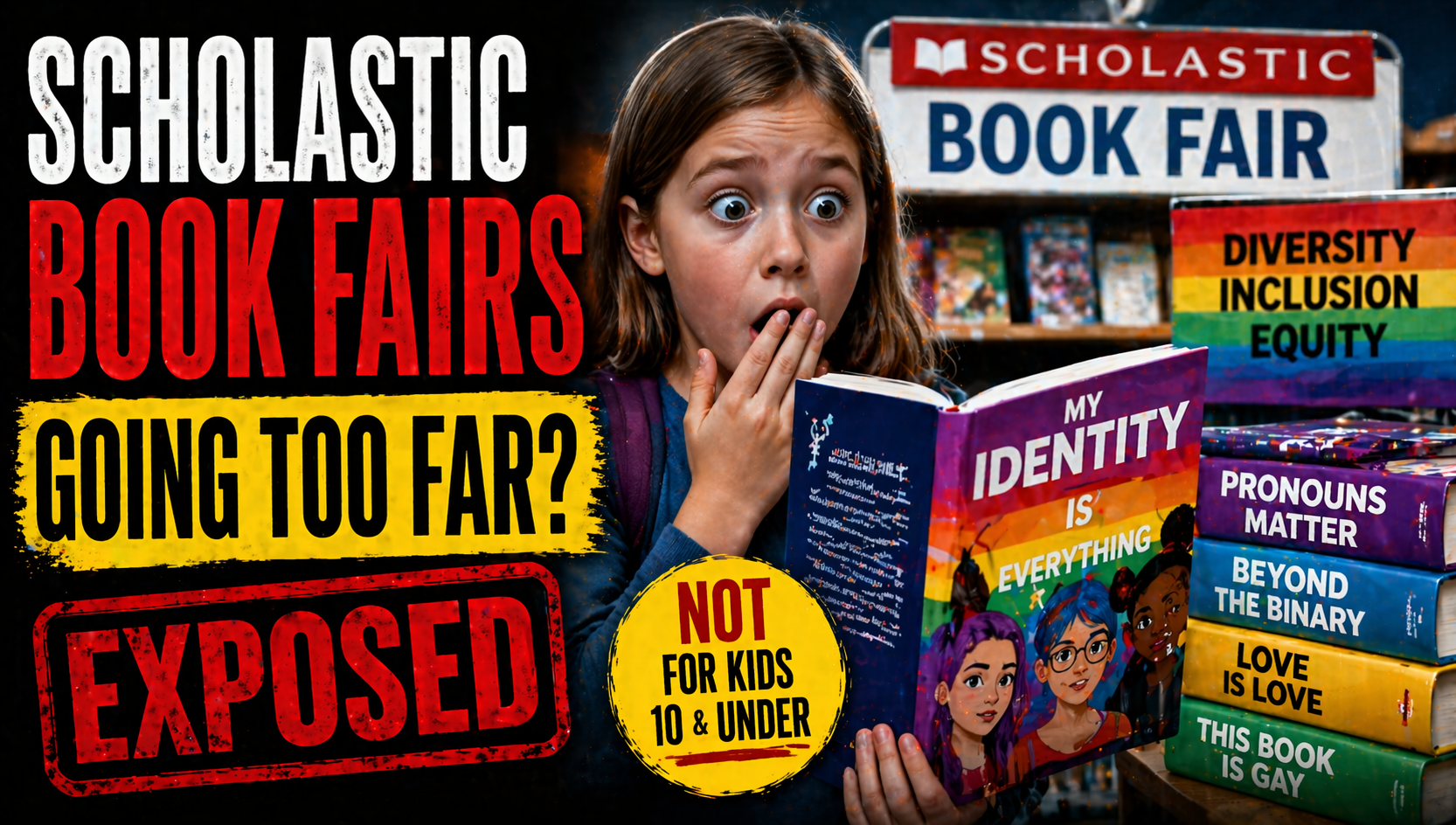
There was a time when the Scholastic book fair meant one thing:
Posters. Pencils. Maybe a Guinness World Records book. And if you were lucky, something about sharks or space.
It felt harmless. Even nostalgic.
But according to Jill Simonian, that experience has changed—and not in a subtle way.
From Book Fair to Battleground
Speaking on The Alex Marlow Show, Simonian didn’t mince words. She argued that today’s fairs are “tilted so far” ideologically, wrapped in the language of inclusion but delivering something very different in practice.
Not just modern.
Not just updated.
But, in her view, radical—and often inappropriate for the age group it’s targeting.
That’s the key tension.
Because parents still picture the book fairs they grew up with.
Meanwhile, critics say the content has quietly shifted under their feet.
The Quiet Shift Parents Didn’t Vote On
The concern isn’t just about a few titles.
It’s about how those titles get there in the first place.
Book fairs are often curated—meaning someone, somewhere, is deciding what kids should see, what gets promoted, and what stays off the table.
And those decisions aren’t always transparent.
For many families, that raises a simple question:
Who decides what a ten-year-old is ready to read?
A parent?
A school?
Or a publishing pipeline with its own priorities?
The Language vs. The Content
Simonian’s criticism centers on something a lot of parents have started to notice—the gap between how books are marketed and what they actually contain.
Terms like:
- “Inclusion”
- “Equity”
- “Representation”
On paper, they sound uncontroversial.
But critics argue those labels can sometimes serve as a kind of shield—discouraging scrutiny while more complex or mature themes make their way into younger grade levels.
Not every book fits that description.
But enough, Simonian argues, to raise concern.
Why It Hits a Nerve
This issue resonates because it touches something deeper than politics.
It’s about trust.
Parents trust schools to educate—not to surprise them.
They trust that age-appropriate still means age-appropriate.
And when that line starts to feel blurry, even slightly, the reaction isn’t subtle.
It’s immediate.
The Bigger Question
At its core, this debate isn’t really about one speaker or one book fair.
It’s about control over early influence.
Childhood is where ideas take root.
And whoever shapes what kids read… shapes how they begin to see the world.
That’s why something as simple as a book fair is suddenly getting a second look.
Because what used to feel like a small, innocent event is now part of a much larger conversation.
One that isn’t going away anytime soon.