

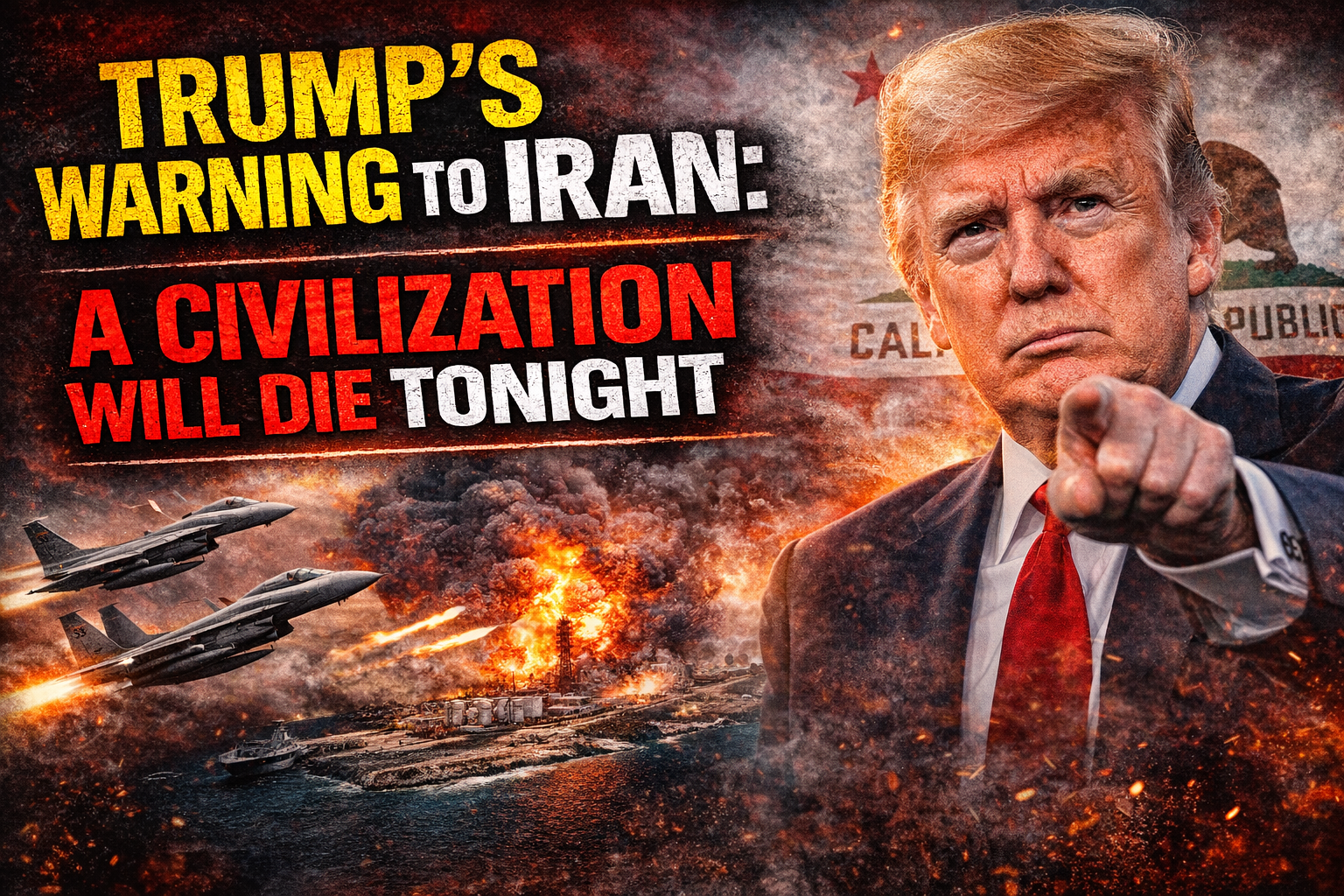
President Donald Trump issued a dramatic warning to Iran on Tuesday, signaling a potential turning point in escalating tensions between the United States and the Iranian regime.
In a post on Truth Social, Trump warned that Iran faces catastrophic consequences if a last-minute resolution is not reached.
“A whole civilization will die tonight, never to be brought back again. I don’t want that to happen, but it probably will,” Trump wrote. “However, now that we have Complete and Total Regime Change, where different, smarter, and less radicalized minds prevail, maybe something revolutionarily wonderful can happen.”
He described the moment as potentially historic, calling it “one of the most important moments in the long and complex history of the world.”
Escalation Follows Earlier Deadline
The warning appears to be a continuation of Trump’s earlier message to Iran, in which he set a firm deadline for action.
In a statement issued Sunday, Trump warned of imminent consequences if Iran failed to comply with U.S. demands, writing that Tuesday would bring significant military action targeting key infrastructure.
“Tuesday will be Power Plant Day, and Bridge Day, all wrapped up in one, in Iran,” Trump said at the time, adding that the scale of action would be unprecedented.
Reports Point to Strike on Key Economic Target
Around the same time as Trump’s latest warning, multiple reports indicated that U.S. forces had struck Kharg Island, a heavily fortified site that serves as the central hub of Iran’s oil exports.
Kharg Island is widely considered one of the most strategically important assets in Iran’s economy. A successful strike on the facility could significantly disrupt the country’s ability to generate revenue, placing immediate pressure on the regime.
While official confirmation remains limited, the reported targeting of Kharg Island suggests a focus on economic leverage rather than purely symbolic or infrastructure-based strikes.
Strategic Messaging and Uncertainty
Trump’s public statements have combined direct threats with ambiguous operational details, a pattern that has characterized his approach to foreign policy messaging.
By referencing potential strikes on power plants and bridges while reports point to attacks on economic infrastructure, the administration may be employing a strategy designed to keep adversaries uncertain about U.S. intentions.
Analysts have noted that such unpredictability can complicate defensive planning and increase pressure on opposing leadership.
Regime Change Signals Raise Stakes
One of the most notable elements of Trump’s statement was his reference to “Complete and Total Regime Change,” language that signals a possible shift beyond deterrence or negotiation.
While it remains unclear whether the phrase reflects a literal objective or a rhetorical escalation, it underscores the seriousness of the current situation and suggests that U.S. goals may extend beyond immediate military outcomes.
A Defining Moment
Trump framed the situation as a pivotal moment not only for Iran, but for global stability more broadly.
The outcome of the current standoff could have far-reaching implications, including impacts on regional security, global energy markets, and the future of U.S. foreign policy strategy.
As developments continue to unfold, attention remains focused on whether Iran will respond diplomatically—or whether the conflict will escalate further.