

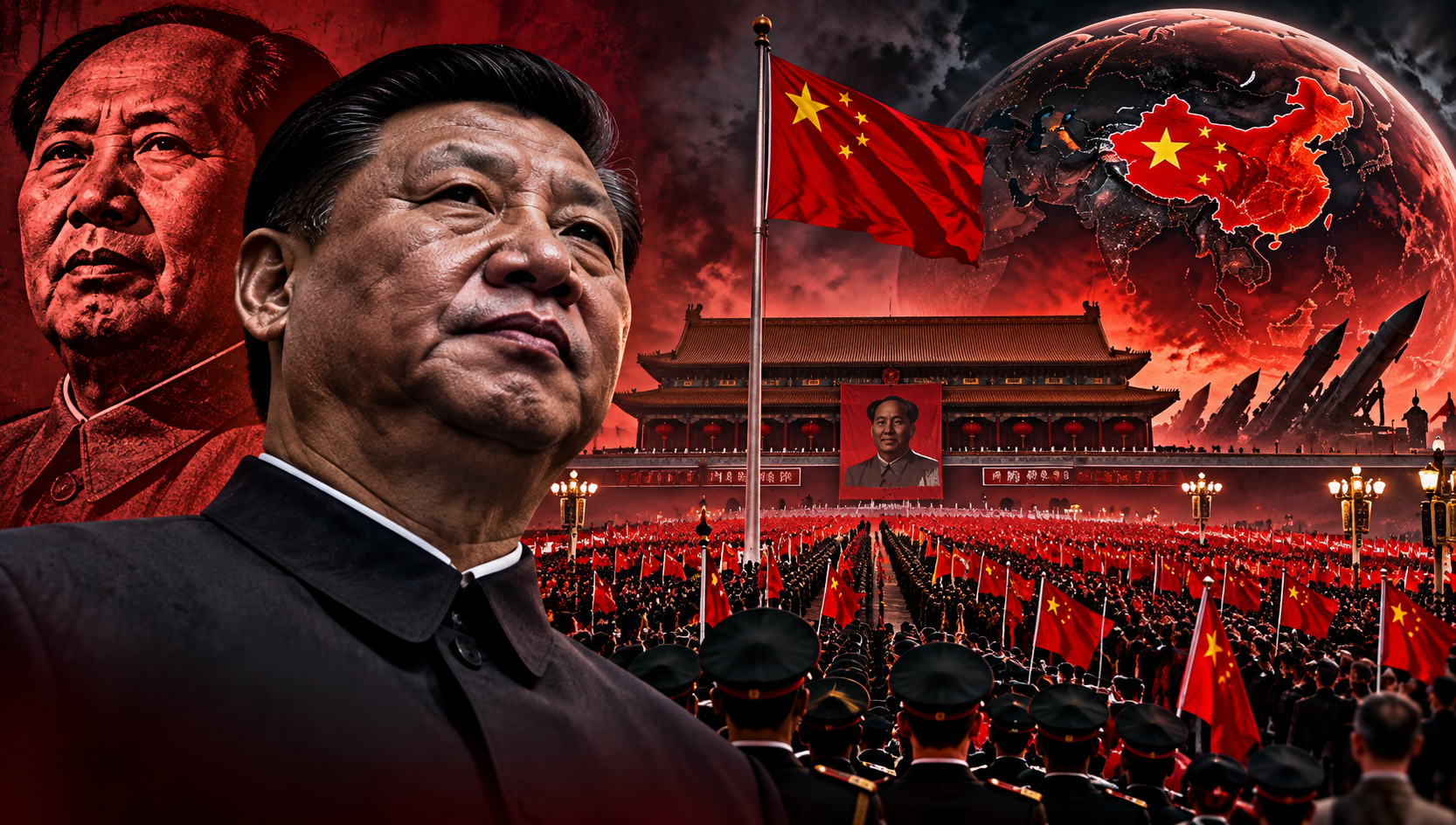
China’s Communist Party celebrated its 77th anniversary in power Thursday with massive flag-raising ceremonies, tributes to Mao Zedong and a lavish banquet for the political elite, commemorating a revolution that ushered in one of history’s deadliest dictatorships.
More than 100,000 people reportedly gathered in Beijing’s Tiananmen Square before dawn to witness the raising of the Chinese flag. The location carries a grim historical significance as the site of the Communist Party’s bloody crackdown on pro-democracy demonstrators in 1989.
The celebrations began Wednesday evening with a banquet attended by approximately 800 officials at Beijing’s Great Hall of the People, where Chinese President Xi Jinping proclaimed that China’s rise could not be stopped.
“The great rejuvenation of the Chinese nation is unstoppable,” Xi declared, according to Chinese state media.
Xi praised the Communist Party’s accomplishments and promised that China would continue its march toward national rejuvenation, a central objective of his administration’s ambitions for greater economic, military and geopolitical power.
Conspicuously absent from the festivities was any meaningful acknowledgment of the staggering human cost of Communist rule.
Mao Zedong, who established the People’s Republic of China on October 1, 1949, presided over political and economic campaigns responsible for tens of millions of deaths.
His Great Leap Forward, an attempt to transform China through forced collectivization and rapid industrialization, triggered a catastrophic famine. Some historical estimates place the death toll as high as 45 million.
The Cultural Revolution subsequently subjected millions of Chinese citizens to political persecution, imprisonment, public humiliation and violence.
Nevertheless, Mao remains a celebrated figure in the Communist Party’s official historical narrative, with authorities encouraging citizens to commemorate his revolutionary achievements.
The anniversary celebrations also extended into Tibet and Xinjiang, known to many Uyghurs as East Turkistan, where Beijing’s treatment of ethnic and religious minorities has drawn international condemnation.
Chinese authorities organized patriotic ceremonies throughout the regions, including activities involving police stationed along remote border areas.
Beijing also extended its patriotic displays into the disputed South China Sea, raising the Chinese flag at Scarborough Shoal, which is claimed by both China and the Philippines.
The ceremony underscored China’s continuing territorial ambitions and its willingness to assert sovereignty over contested territory.
Meanwhile, Xi reaffirmed his vision of national rejuvenation, which includes Beijing’s longstanding objective of bringing Taiwan under Communist Party control.
China considers the self-governing democracy part of its territory, despite never having governed it under the People’s Republic.
Even Chinese astronauts joined the celebrations, praising the country’s space program as a symbol of its technological achievements and growing international influence.
For Beijing, the anniversary was an opportunity to project strength, unity and confidence in the Communist Party’s future.
For critics of the regime, it was also a reminder of the political repression, historical atrocities and territorial disputes that remain inseparable from the party’s legacy.
Seventy-seven years after Mao’s revolution, the Communist Party remains firmly in control, and Xi Jinping is promising that China’s rise has only just begun.