

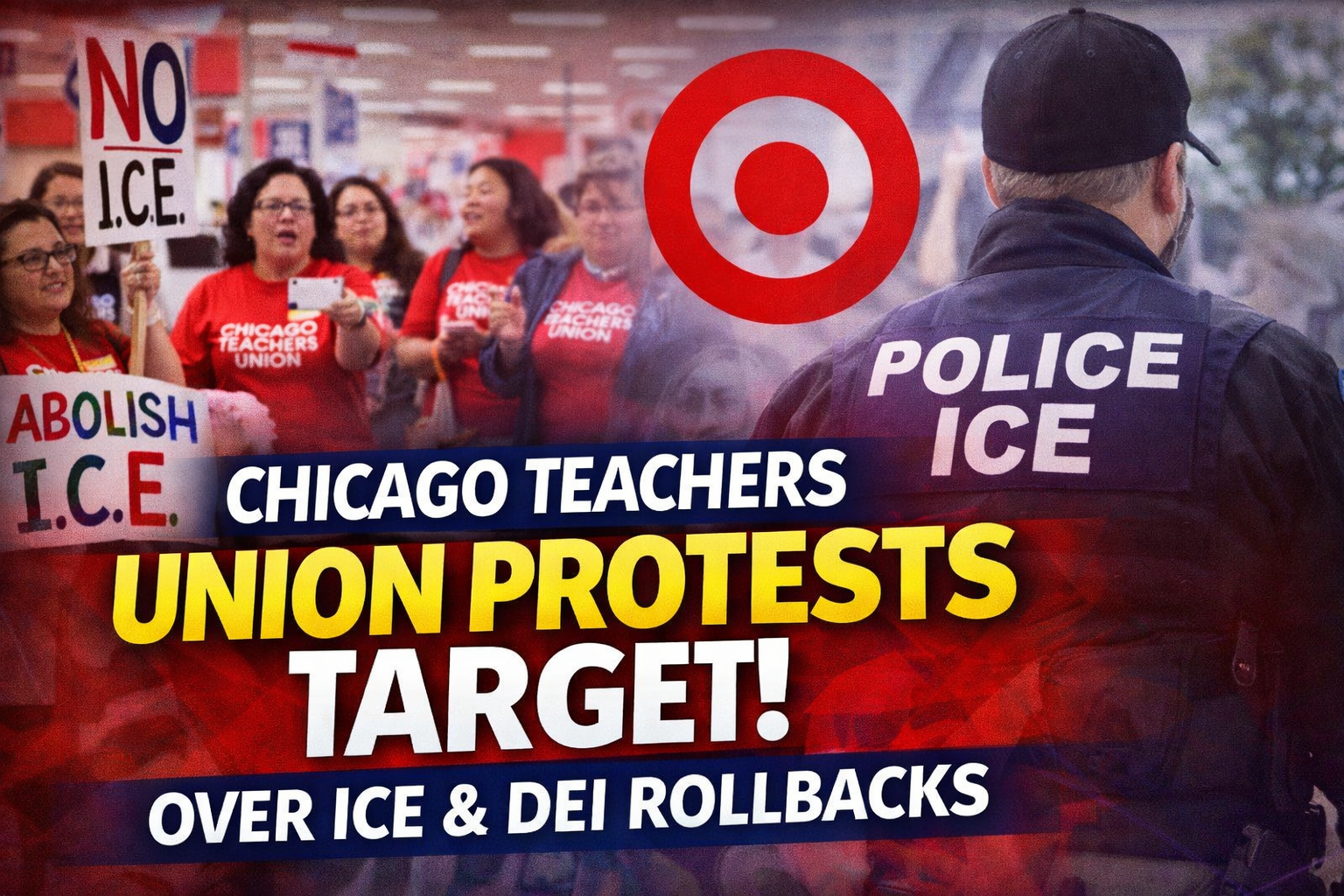
Members of the Chicago Teachers Union are facing mounting criticism after filming themselves confronting employees and shoppers inside a Chicago-area Target store to protest federal immigration enforcement and corporate rollbacks of diversity, equity, and inclusion (DEI) policies.
The protest, which took place on a Friday and was later posted by the union on social media, showed CTU members entering the store holding anti-ICE signs, demanding that Target publicly commit to resisting immigration enforcement actions, and pressuring staff over whether the company would “protect” employees from federal agents.
In its post, the union argued that Target was failing its workers by not explicitly blocking immigration authorities from entering its stores and by retreating from DEI commitments. The post accused the retailer of “bowing to pressure” from the Trump administration and allowing harm to employees and customers.
The response online was swift — and largely negative.
Backlash Over Union Priorities
Critics from across the education and policy world questioned why a teachers union was targeting a private retailer over federal law enforcement rather than focusing on student outcomes in Chicago Public Schools.
“The CTU can’t help itself — they feel compelled to weigh in on every political issue,” the Teacher Freedom Alliance wrote in response. “And they bankroll these so-called ‘protests’ with your tax dollars.”
Education advocates echoed that sentiment. Erika Donalds, chair of education opportunity at the America First Policy Institute, said the protest revealed what she described as a fundamental disconnect between union leadership and classroom realities.
“While kids are falling behind in reading and math, union leaders are staging protests over immigration enforcement,” Donalds said. “They don’t speak for teachers, they don’t serve students, and at this point they barely even pretend to care about education.”
“Naked Intimidation” of Workers
Others criticized the tactic itself — confronting hourly retail employees over policies set by corporate leadership and federal law.
Nicole Neily, founder and president of Defending Education, described the protest as coercive rather than principled.
“Union thugs bullying hourly employees in Target stores isn’t brave or just — it’s naked intimidation of people who are simply trying to earn a paycheck,” Neily said.
The CTU video shows employees visibly uncomfortable as protesters demand answers about immigration enforcement that store workers have no authority to control.
Education Outcomes Lag as Activism Expands
The controversy comes as Chicago Public Schools continues to struggle with academic performance. According to recent data, a majority of CPS students are not proficient in reading or math, with particularly severe gaps in elementary and middle grades.
Even outlets typically sympathetic to organized labor have taken notice. Earlier this month, The Washington Post published an editorial criticizing the CTU for prioritizing sweeping social justice goals while core educational outcomes deteriorate.
“In 2025, 43 percent of Chicago’s third through eighth grade students were reading at grade level,” the editorial noted, questioning whether union activism had eclipsed its responsibility to students.
Immigration Enforcement as a Political Flashpoint
The CTU protest also reflects broader tensions surrounding U.S. Immigration and Customs Enforcement, which has become a frequent target of progressive activism despite operating under federal law.
Union leaders have framed resistance to immigration enforcement as a civil rights issue, pledging to “defend Black and brown and immigrant communities” from federal action. Critics argue that stance drags schools — and now retailers — into political battles far removed from education.
Fox News Digital reported that the union did not respond to requests for comment.
A Growing Divide
For many observers, the episode underscores a widening gap between teachers unions’ political ambitions and the expectations of parents, taxpayers, and even rank-and-file educators.
As Chicago students continue to lag academically, critics say the sight of union members staging filmed confrontations inside big-box stores raises uncomfortable questions about priorities — and about who, exactly, today’s teachers unions are working for.