

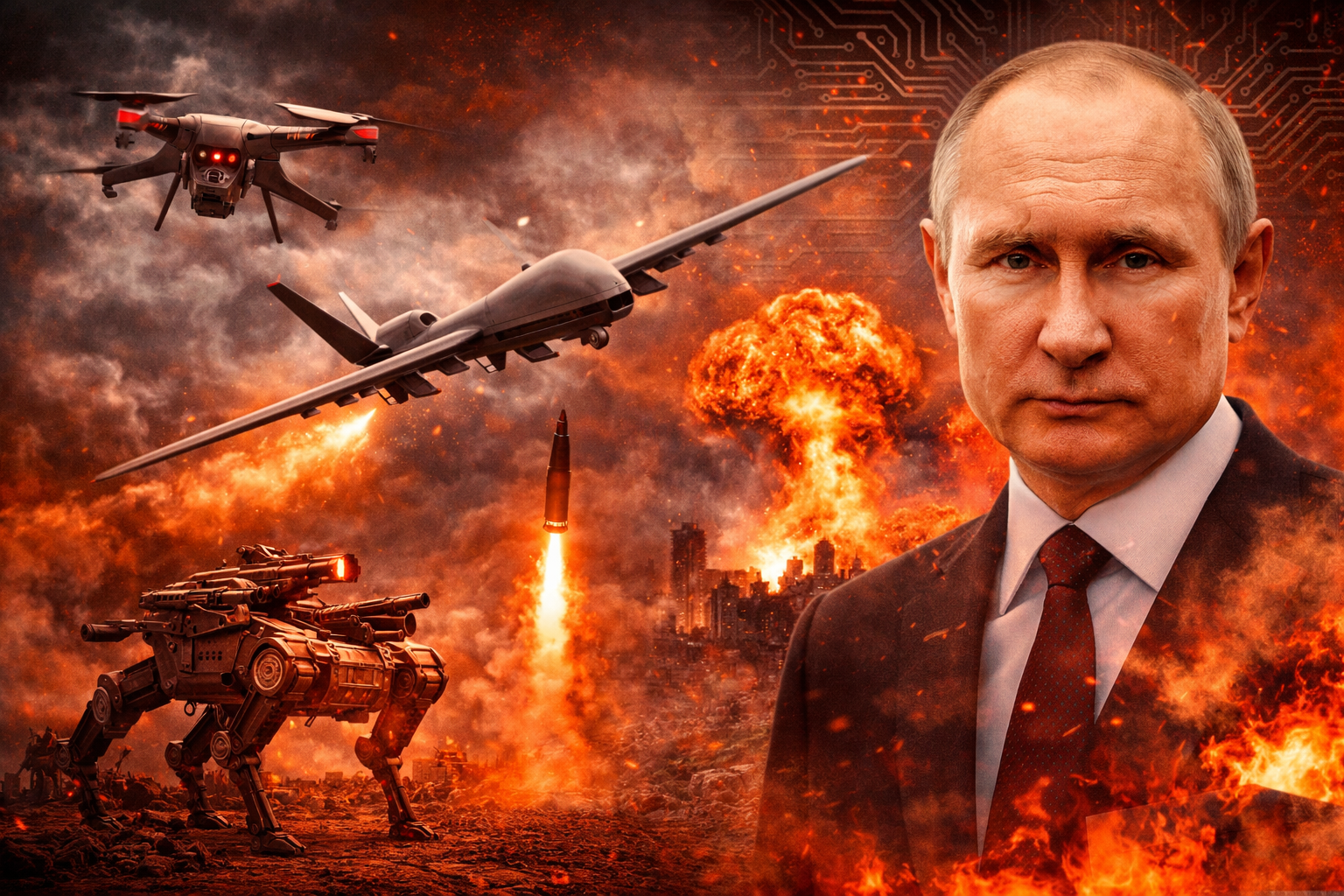
Wynton Hall’s Code Red delivers a chilling warning: autonomous AI weapons are about to reshape warfare just as radically as nuclear weapons once did—but this time, there’s no easy way to contain it.
Unlike nuclear technology, which requires rare materials and massive infrastructure, AI is cheap, accessible, and spreading fast. The barrier to entry is collapsing. Hall points to a stark turning point in 2020, when autonomous weapons reportedly hunted and killed human targets in Libya without direct human control. That line has already been crossed.
This isn’t just a superpower game anymore.
“The democratization of lethal AI weaponry,” Hall warns, means tools once reserved for global powers are now within reach of smaller states—and even non-state actors.
At the highest level, the stakes are escalating fast. Israel’s use of AI in Gaza showed just how powerful these systems can be—processing intelligence and identifying targets at speeds human analysts simply cannot match. Once those systems are paired with autonomous weapons, the world moves closer to what Hall calls “hyperwar”—a battlefield where speed is everything and hesitation is fatal.
In that environment, slowing down to keep humans “in the loop” could become a liability.
“In the kill-or-be-killed reality of combat,” Hall writes, “a nanosecond delay might send an American soldier home in a flag-draped coffin.”
The logic is brutal and unavoidable: if your enemy lets AI operate freely, you will be forced to do the same. And once both sides cross that threshold, war becomes something entirely different—machines fighting at speeds humans can’t control, and can’t meaningfully intervene in.
Meanwhile, America faces a unique disadvantage. Hall notes that U.S. tech companies and workers often resist military partnerships, while rivals like China and Russia face no such internal opposition. Their governments move in lockstep with their tech sectors, accelerating development without hesitation.
That gap could prove decisive.
Still, there are signs the tide may be turning, as even Silicon Valley begins to recognize the risks of falling behind authoritarian regimes in the race for AI dominance.
The stakes couldn’t be clearer. As Vladimir Putin once put it, “whoever becomes the leader in this sphere will become the ruler of the world.”
At its core, AI is simply a tool—one that makes everything faster and cheaper. But in warfare, that means faster killing, faster decisions, and fewer barriers to entry. Today’s autonomous weapons are the evolution of something as simple as a landmine—but infinitely more dangerous. They don’t just wait. They think, track, decide, and strike.
And soon, they won’t just belong to nations.
They’ll be in the hands of anyone who can afford them.
That’s the reality Code Red lays out: a world where the power once held by superpowers is now within reach of the smallest—and most dangerous—actors. And a warning that if the United States doesn’t lead, it risks falling behind in the most consequential arms race of the modern era.