

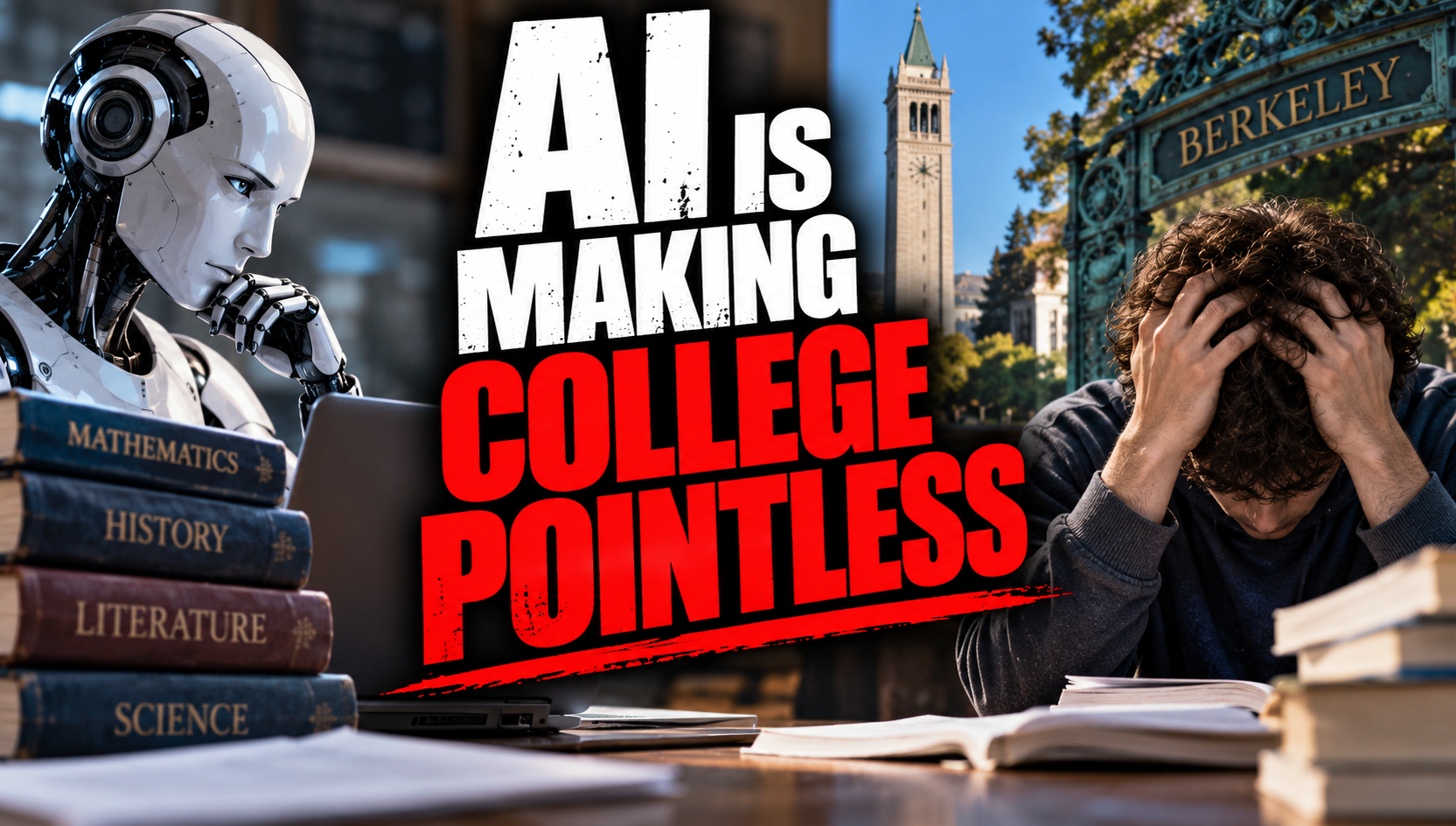
A Fields Medal-winning mathematician has stopped grading students on correct answers, warning that artificial intelligence is making traditional education increasingly difficult to justify.
One of the world’s most accomplished mathematicians has effectively surrendered to artificial intelligence in his own classroom.
Richard Borcherds, a mathematics professor at the University of California, Berkeley, and recipient of the prestigious Fields Medal, has stopped grading homework assignments for accuracy because students can now use AI to produce correct answers without understanding the material.
Instead, students receive credit simply for completing their assignments, regardless of whether their answers are right or wrong.
“Student use of AI for homework is now widespread,” Borcherds told the California Post. “Grading for correctness just adds a huge incentive for them to use AI for homework instead of doing it themselves, and penalizes students for honesty.”
The decision reflects a growing crisis in higher education. Universities have spent decades building academic systems around assignments, essays, and examinations intended to measure students’ understanding. AI can now complete much of that work in seconds, often producing results that instructors cannot reliably distinguish from genuine student effort.
Borcherds, who received the Fields Medal in 1998 for his contributions to mathematics, believes attempting to identify AI-generated assignments is largely futile.
“There is no easy way to tell the difference between human and AI generated work,” he explained. Earlier AI systems frequently made recognizable mistakes, but improvements in the technology have made those errors increasingly uncommon.
The result is an uncomfortable dilemma for educators. Grade homework based on accuracy, and students who use AI may outperform classmates who complete the work honestly. Abandon accuracy-based grading, and assignments lose much of their value as measures of learning.
Borcherds has chosen the latter approach, although he acknowledges that it is far from ideal.
The problem extends well beyond mathematics.
Universities have experimented with AI-detection software, including Turnitin and Rumi, but UC Berkeley has reportedly determined that existing tools are not sufficiently reliable to justify a standardized campus-wide system.
Such programs have also created problems of their own.
AI detectors typically evaluate statistical patterns in writing rather than establishing who actually wrote a passage. Word choice, sentence structure, and linguistic complexity can influence their assessments, potentially flagging original student work as artificially generated.
In one reported example, a student’s essay about Kurt Vonnegut’s Harrison Bergeron received an 18% AI-generated score. Replacing the word “devoid” with “without” reportedly reduced the score to zero.
The implications are troubling. Students may find themselves rewarded for producing simpler, less sophisticated writing while those using AI face little risk of detection.
But Borcherds is concerned about something considerably larger than cheating.
In an interview with UC Berkeley’s student newspaper, The Daily Californian, he questioned whether mathematics itself will remain a viable career for human beings.
“If AI continues to improve at present rate, then, in a few years, there’ll be nothing human mathematicians can do that AI can’t do better,” he warned.
The professor admitted that he no longer knows whether to recommend mathematics as a major. Only five years ago, the profession appeared relatively insulated from automation, requiring advanced reasoning and creative problem-solving that computers struggled to replicate.
That assumption is now being challenged.
Borcherds compared the transformation to earlier technological revolutions that displaced entire occupations, including mechanized looms replacing hand weaving and automobiles replacing horses.
The difference, he noted, is that mathematics has never experienced anything quite like this.
The consequences for universities could be profound.
If students can obtain correct answers without understanding the underlying concepts, academic credentials may become increasingly disconnected from actual competence. A passing grade would no longer necessarily demonstrate mastery of a subject, only the ability to submit acceptable work.
And if AI eventually becomes more capable than the professionals universities are training, students may begin questioning the value of spending years and tens of thousands of dollars pursuing degrees in fields undergoing rapid automation.
Borcherds himself appears uncertain about what comes next.
“I have no idea what to advise,” he told The Daily Californian, adding that he even asked ChatGPT about the future of mathematics and received no definitive answer.
For now, the professor has adopted a grading system that acknowledges the limitations of traditional homework in an AI-dominated classroom.
But the larger question remains unanswered: What is the purpose of an education if students no longer need to demonstrate that they can do the work themselves?
Borcherds offered a sobering assessment of the situation.
“If the worst effect of AI on society is that it is harder to assess homework then I will be very relieved,” he told the California Post.
For a mathematician who has spent his career solving problems others considered nearly impossible, the inability to find a solution to this one may be the most revealing detail of all.