

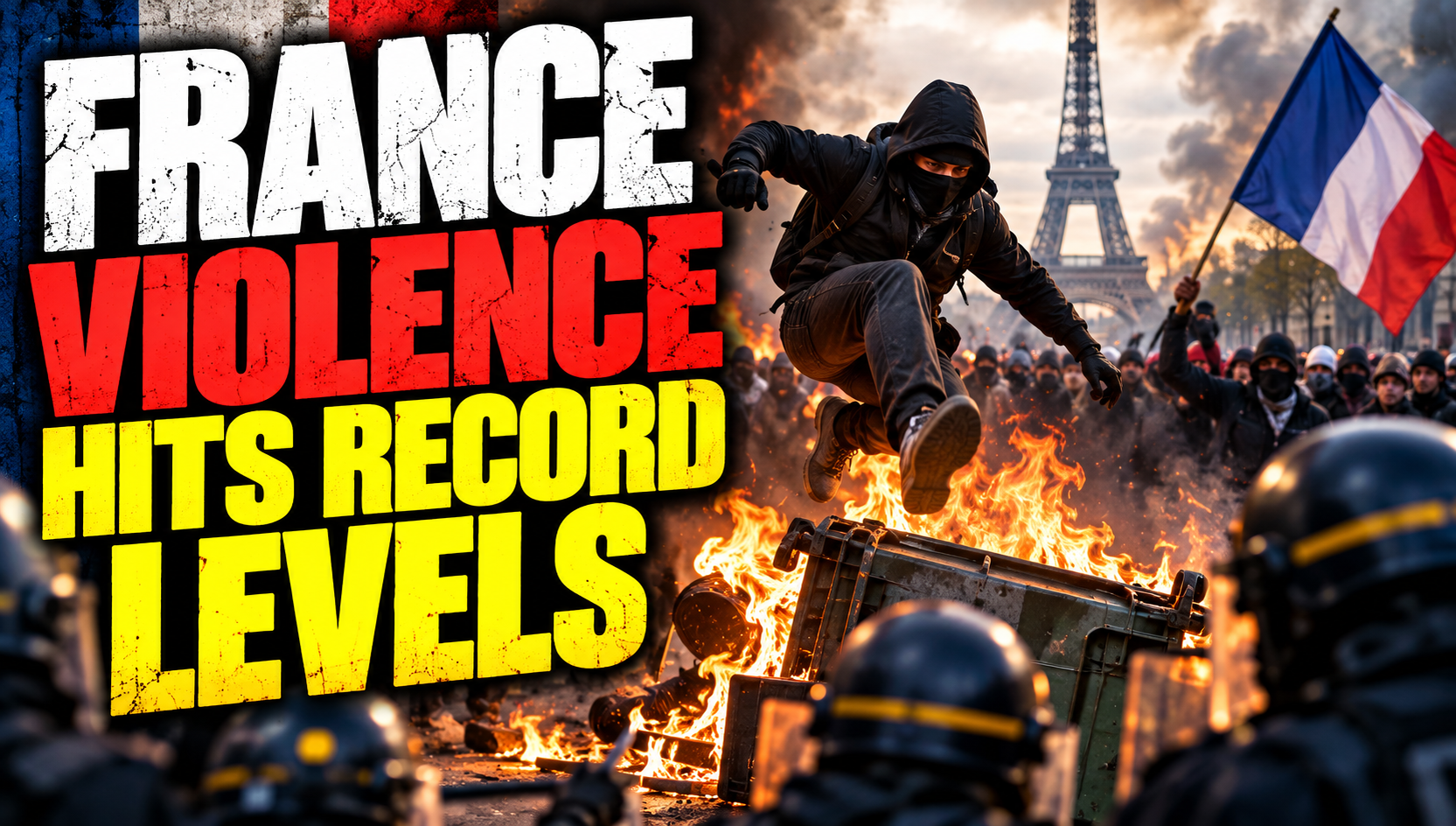
France is confronting a rapidly escalating public-order crisis as government figures show street violence reaching record levels while student demonstrations descend into riots across the country.
According to French Interior Ministry data reported by Le Figaro, approximately 20,000 incidents of violence in public spaces were recorded in September. That works out to nearly 700 incidents every day and represents a seven percent increase from August.
The surge coincides with a youth protest movement that began with school blockades in late September and has since spread across France. Demonstrations over school conditions have increasingly been accompanied by burning trash cans, attacks on police, vandalism and clashes with authorities.
Tuesday brought another extraordinary show of force.
More than a quarter-million people reportedly participated in demonstrations nationwide, including approximately 56,000 in Paris. Disorder was also reported in Strasbourg, Rennes, Châteauroux and Toulouse.
Police arrested at least 488 people Tuesday, while 43 officers were injured. Since the demonstrations began, nearly 6,000 arrests have reportedly been made and close to 800 police officers injured.
The unrest has disrupted hundreds of secondary schools and forced the government to take increasingly drastic measures. High school classes were suspended for the remainder of the week in an attempt to contain the upheaval.
French criminologist Alain Bauer warned that the problem extends beyond any single protest movement. He described a society becoming “TikTok-ized,” with some young people increasingly “uninhibited, sometimes nihilistic” and convinced that their actions carry few consequences.
Frédéric Lauze, head of France’s National Police Commissioners’ Union, offered a similar diagnosis. He said the violence is becoming “harsher and more difficult to anticipate,” blaming what he described as a growing sense of impunity among people who no longer fear consequences from the justice system.
The unrest has also become deeply political.
Far-left presidential candidate Jean-Luc Mélenchon appeared at Tuesday’s demonstration in Paris. His La France Insoumise party has been accused by police officials of encouraging or exploiting the youth movement, allegations the party and its allies dispute.
The political character of the demonstrations was difficult to miss. Protesters carried Communist and Palestinian flags, displayed signs reading “ACAB” and “Down with the police state,” and chanted, “We are all antifascists.”
Particular attention has fallen on Saint-Denis Mayor Bally Bagayoko, a La France Insoumise politician who has publicly joined demonstrations in the heavily immigrant Paris suburb.
Bagayoko was previously filmed near a burning trash can while demonstrators chanted his name. He maintained that he was attempting to extinguish the fire.
Paris police, however, have accused elements of the far left of encouraging the unrest and specifically criticized Bagayoko’s rhetoric surrounding violent reactions to law enforcement.
Éric Ciotti, the mayor of Nice and leader of the UDR party, has now called for Bagayoko to be removed from office.
“He is fuelling the violence even though he is a judicial police officer and represents the State!” Ciotti said Tuesday.
The French public appears to have little patience for politicians seen as encouraging the disorder. A CSA poll conducted for Europe 1 found 83 percent of respondents believed politicians who encourage youth violence should face criminal prosecution.
There are also growing demands that parents be held financially responsible for destruction caused by their children, including proposals to dock welfare benefits to recover damages.
France has endured riots before. What makes the present crisis particularly alarming is its scale, its speed and the increasingly open involvement of national political movements.
What began as student anger over conditions in French schools has become something much larger.
And with hundreds of police officers already injured and thousands of arrests made, France is discovering just how quickly a protest movement can become a national crisis.