

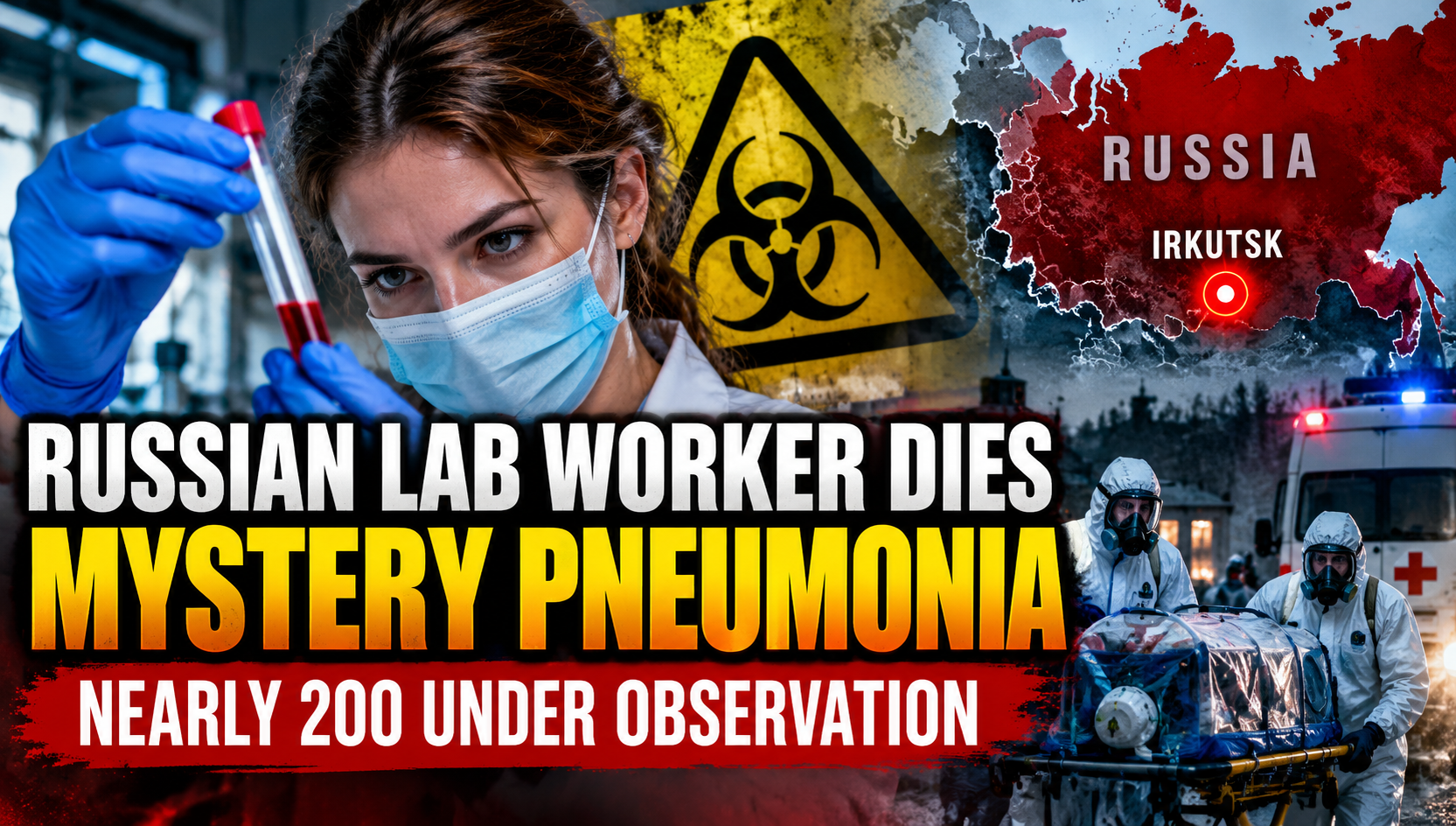
A young scientist working at a Russian laboratory dedicated to studying some of the world’s deadliest diseases has died from a mysterious case of pneumonia, prompting quarantines, the monitoring of nearly 200 people, and international scrutiny over what exactly happened inside the facility.
The woman, identified by local media as 28-year-old Daria Shipilova, worked at the Irkutsk Anti-Plague Institute of Siberia and the Far East. She died Friday after being hospitalized with what Russian authorities described as “pneumonia of unknown etiology.”
Russian officials insist there is no evidence her death was connected to her laboratory work.
But the circumstances surrounding the case have raised questions that officials have yet to fully answer.
Nearly 200 people who came into contact with Shipilova are reportedly under medical observation. Two hospitals and a children’s clinic were placed under quarantine, public events in Irkutsk were canceled, and some reports claim the Anti-Plague Institute itself was temporarily quarantined.
Eyewitnesses have also reported seeing people wearing protective equipment in the streets of nearby Shelekhov.
The U.S. government is now watching.
“Many details have not been confirmed,” the State Department said Monday, urging Russian authorities to release accurate information quickly and openly.
Secretary of State Marco Rubio said the situation was not currently a reason for panic, but warranted close attention.
“I don’t think it’s cause for alarm, but it is cause for focus and a cause to just keep an eye on it,” Rubio said.
The World Health Organization has likewise cautioned against jumping to conclusions. It said no cause of death has been officially established and that, based on the information currently available, the risk to the general public appears low.
So far, no additional infections have been reported among Shipilova’s contacts.
Still, conflicting accounts of what happened before her illness have fueled speculation.
Some Russian media reports claim Shipilova recently traveled near the Mongolian border. Another account says she had recently visited Thailand. More alarmingly, some local reports allege that she dropped a test tube containing plague bacteria while working at the institute last month and subsequently became ill.
That claim has not been officially confirmed.
Russian authorities say testing found no microorganisms associated with Shipilova’s professional activities in samples taken from her body.
Yet questions remain about the scale of the response.
Rospotrebnadzor, the Russian agency overseeing the institute, has not publicly explained why numerous employees were reportedly isolated and multiple medical facilities faced restrictions if authorities had already ruled out an occupational infection.
The Kremlin is asking the public to trust the government.
“It is their official statements that should be relied upon, rather than paying heed to various rumors, speculations, and the like,” Kremlin spokesman Dmitry Peskov said.
After the COVID-19 pandemic, however, reports of a mysterious respiratory death involving an employee of a laboratory studying dangerous pathogens are inevitably going to attract attention.
Health experts stress that even if plague were eventually confirmed, that would not mean another pandemic was imminent.
Bubonic plague is generally transmitted from animals to humans, often through infected fleas. If the bacteria spread to the lungs, the disease can develop into pneumonic plague, which can spread between people through respiratory droplets. Modern antibiotics can treat plague when administered promptly.
Former White House COVID response coordinator Dr. Ashish Jha said the odds of the incident becoming a major outbreak are extremely small.
“We may see a few more people get infected, but the chances that this becomes a larger outbreak, let alone a global pandemic, is exceedingly low,” Jha said.
But Jha identified one question that could dramatically change the assessment: what kind of research was actually being conducted inside the laboratory.
“If there were weapons programs, biological weapons programs in these labs, that would be much more concerning to me,” he said. “We need to understand that now.”
For the moment, there is no confirmed evidence of a laboratory leak, a plague outbreak, or a biological weapons connection.
There is, however, a dead 28-year-old anti-plague laboratory employee, nearly 200 people being monitored, quarantines and restrictions at multiple medical facilities, and a Russian government asking the world to trust its assurances while many basic details remain unclear.
After the last pandemic, “trust us” is unlikely to end the questions.