

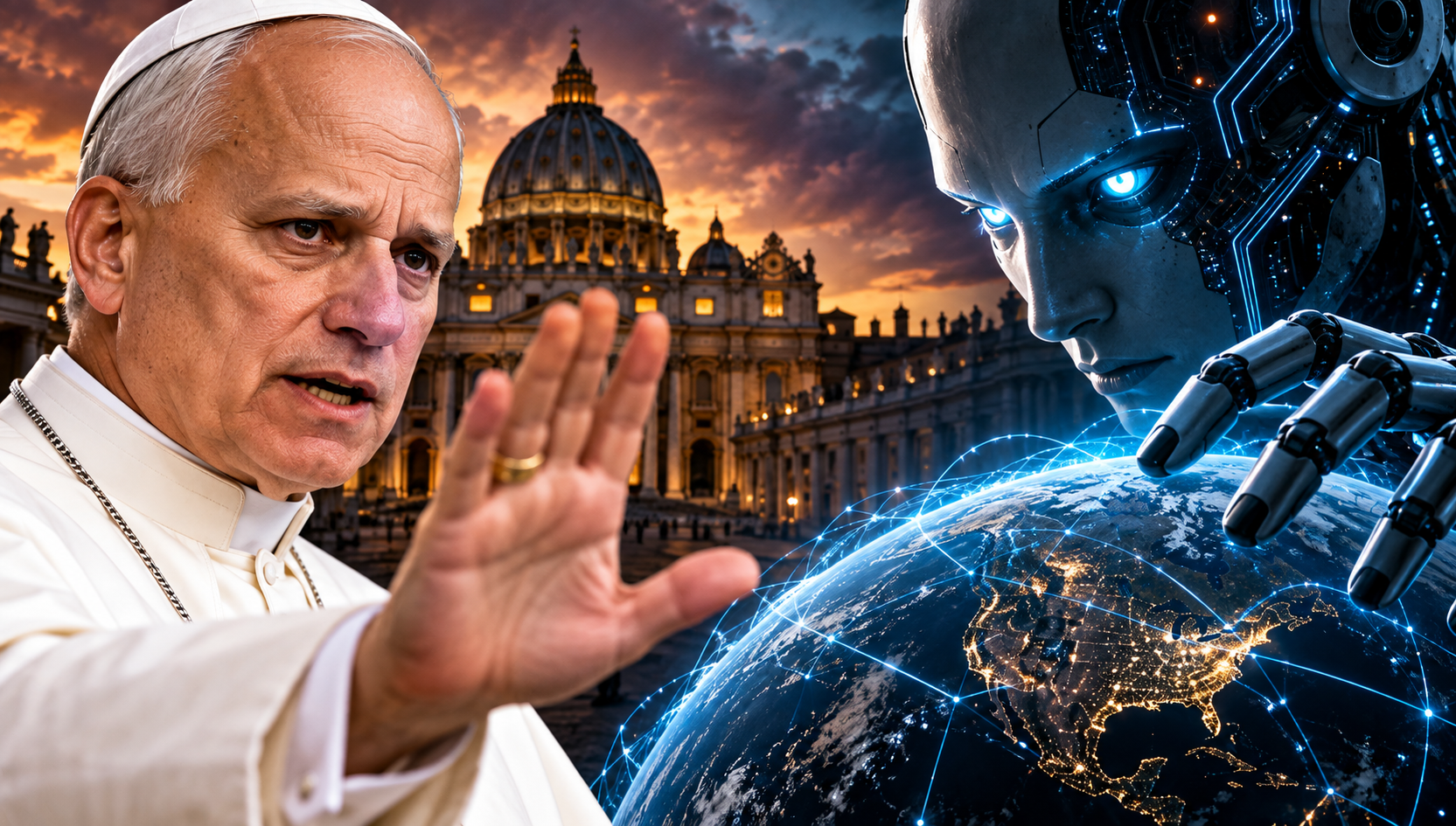
Pope Leo XIV has a warning for a world racing headlong into artificial intelligence: stop pretending nothing can go wrong.
Speaking to reporters aboard the papal plane Monday, Leo rejected the idea that fears about advanced AI are simply hysteria or “fake news.”
“This is a problem that, I think, we need to sit down and talk about,” Leo said. “We can’t just sit back and pretend nothing is going to happen.”
The comments put the American-born pope squarely into one of the biggest technological debates of the moment.
President Donald Trump has taken a markedly more optimistic approach, arguing that America cannot allow excessive restrictions to slow development while China races ahead. On Tuesday, Trump announced a voluntary agreement with major technology companies to police their own AI development, rather than imposing sweeping new federal guardrails.
Vice President JD Vance has likewise cautioned against allowing fears about AI to produce a regulatory regime that could benefit the biggest technology companies while crushing smaller competitors.
Leo isn’t calling for panic.
In fact, he specifically said he isn’t in “panic mode” over predictions of an AI apocalypse. His argument is simpler: when some of the people building the most powerful AI systems on Earth are warning that those systems could become dangerous, governments probably shouldn’t just shrug.
And those warnings aren’t coming from science-fiction writers.
Executives and researchers at companies including OpenAI and Anthropic have publicly pushed for stronger safety measures and independent testing of increasingly capable AI systems. At the same time, critics have questioned whether calls for regulation from the industry’s biggest companies could conveniently help those same companies entrench their positions against smaller competitors.
That leaves policymakers with an uncomfortable problem.
What if the AI companies are right about the danger, but their proposed solution also gives them enormous power over the future of the industry?
Leo’s answer isn’t to hand Silicon Valley whatever regulations it wants. It’s to take the underlying problem seriously.
“We need to continue to invite political leaders, leaders of AI, social organizations, associations to come together and look at what is happening already and what could be down the road,” the pope said.
This isn’t a new concern for Leo.
Days earlier, he warned the Pontifical Academy of Sciences that AI could be used for surveillance, manipulation and discrimination. He also pointed to the dangers posed by autonomous weapons and sophisticated cyber capabilities operating without adequate safeguards or human control.
At UNESCO, Leo went even further into the philosophical problem.
Computers may increasingly be described as possessing “intelligence,” he argued, while societies simultaneously risk reducing actual human beings to measurements of efficiency and productivity. AI can process staggering quantities of information, but that doesn’t mean a machine can answer the fundamental questions of human existence.
That’s ultimately where the pope’s warning lands.
The debate isn’t simply about whether AI will someday turn into a Hollywood killer robot.
It’s about how much authority humans are prepared to surrender to systems they increasingly depend upon but don’t always fully understand.
America may indeed be in an AI race with China. Excessive regulation could carry enormous economic and national-security costs. And tech companies asking Washington to regulate their own industry deserve scrutiny.
But none of that makes the risks disappear.
Leo’s message is essentially this: race if you must. Just don’t close your eyes while you’re running.