

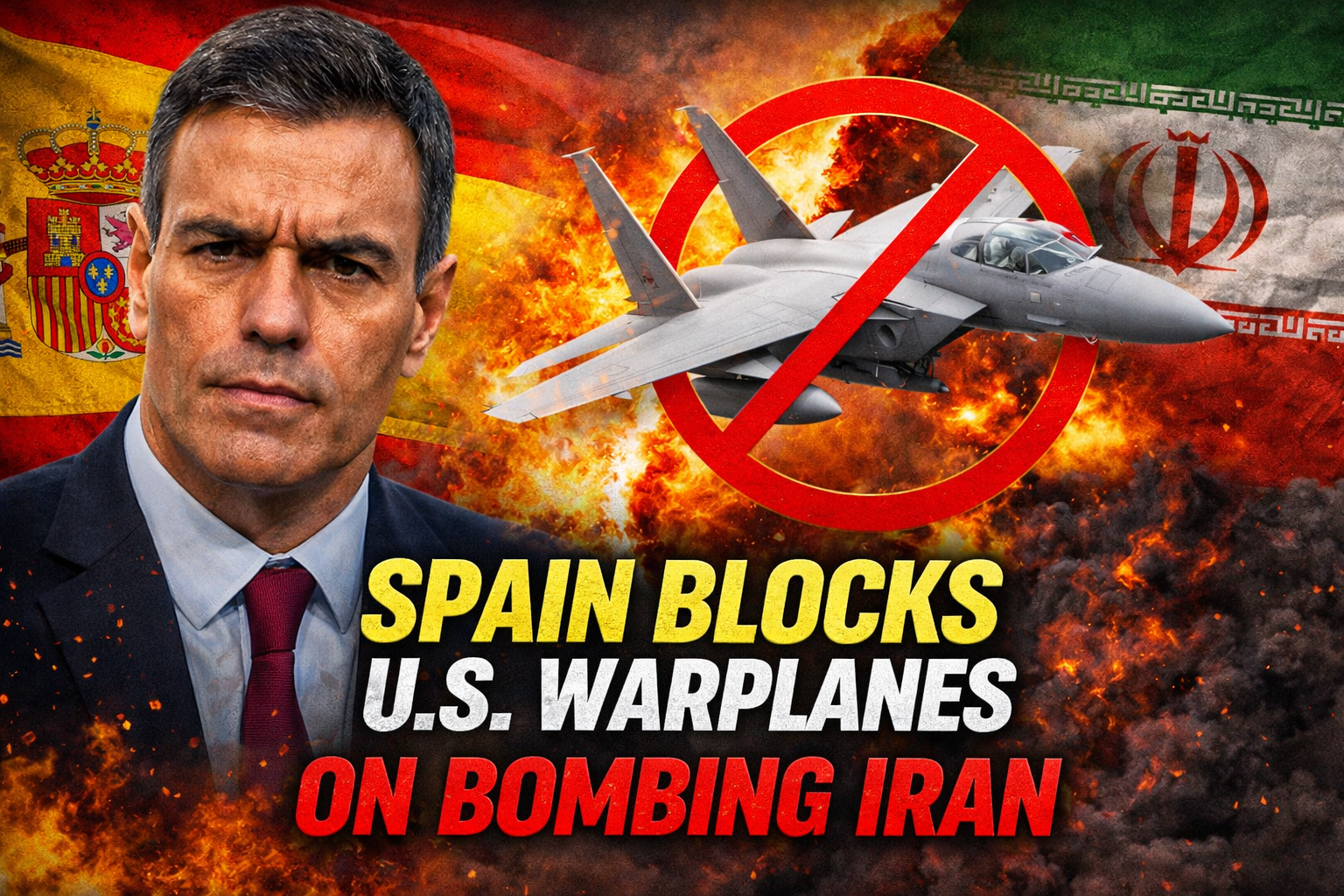
In a move that’s sending shockwaves through NATO, Spain has effectively drawn a red line against Washington — blocking U.S. warplanes tied to Operation Epic Fury from its airspace and military bases.
Not quietly. Not diplomatically. Publicly.
A NATO Ally Breaks Rank
According to reports, Spain has barred U.S. aircraft involved in strikes on Iran from:
- Entering Spanish airspace
- Using key military bases in Rota and Morón
- Even refueling on Spanish soil
And it doesn’t stop there.
The restriction reportedly extends to U.S. aircraft operating out of allied countries like the United Kingdom and France — a sweeping denial that cuts directly into America’s logistical flexibility in Europe.
This isn’t symbolic. It’s operational.
“We Will Not Escalate This War”
Spain’s Foreign Minister José Manuel Albares made the reasoning clear: Spain will not participate in anything that escalates the conflict.
Prime Minister Pedro Sánchez went even further, calling the war “illegal” and confirming that all flight plans tied to Iran operations have been rejected.
Every single one.
That includes refueling aircraft — a critical piece of long-range strike capability.
The Reality: Quiet Cooperation Still Exists
Despite the hardline rhetoric, the situation is more complicated behind the scenes.
Spain continues to:
- Support U.S. troop logistics in Europe
- Allow existing bilateral military agreements to remain intact
- Provide air traffic coordination for long-range U.S. bombers
In fact, B-2 stealth bombers flying 30+ hour missions to strike Iran are still being tracked and supported — they’re just rerouted to avoid Spanish airspace.
So while Spain is publicly distancing itself, it’s not completely severing ties.
It’s walking a tightrope.
A Strategic Snub — Or Political Theater?
Spain’s decision raises a deeper question: is this about principle, or positioning?
By framing the war as illegal and invoking the United Nations Charter, Sánchez’s government is signaling alignment with a broader European hesitation toward escalation.
At the same time, Spain insists there will be no fallout with Washington — no trade consequences, no retaliation.
That’s a bold bet.
Because from the U.S. perspective, this isn’t neutrality.
It’s obstruction.
What This Means Going Forward
Spain’s move exposes a growing fracture inside NATO at a critical moment.
On one side: a U.S.-led military campaign escalating pressure on Iran.
On the other: European allies trying to avoid being pulled deeper into the conflict.
The result?
A divided alliance navigating a war that’s getting harder to contain.
And as Operation Epic Fury continues, one thing is now clear:
Even America’s allies aren’t fully on board.