

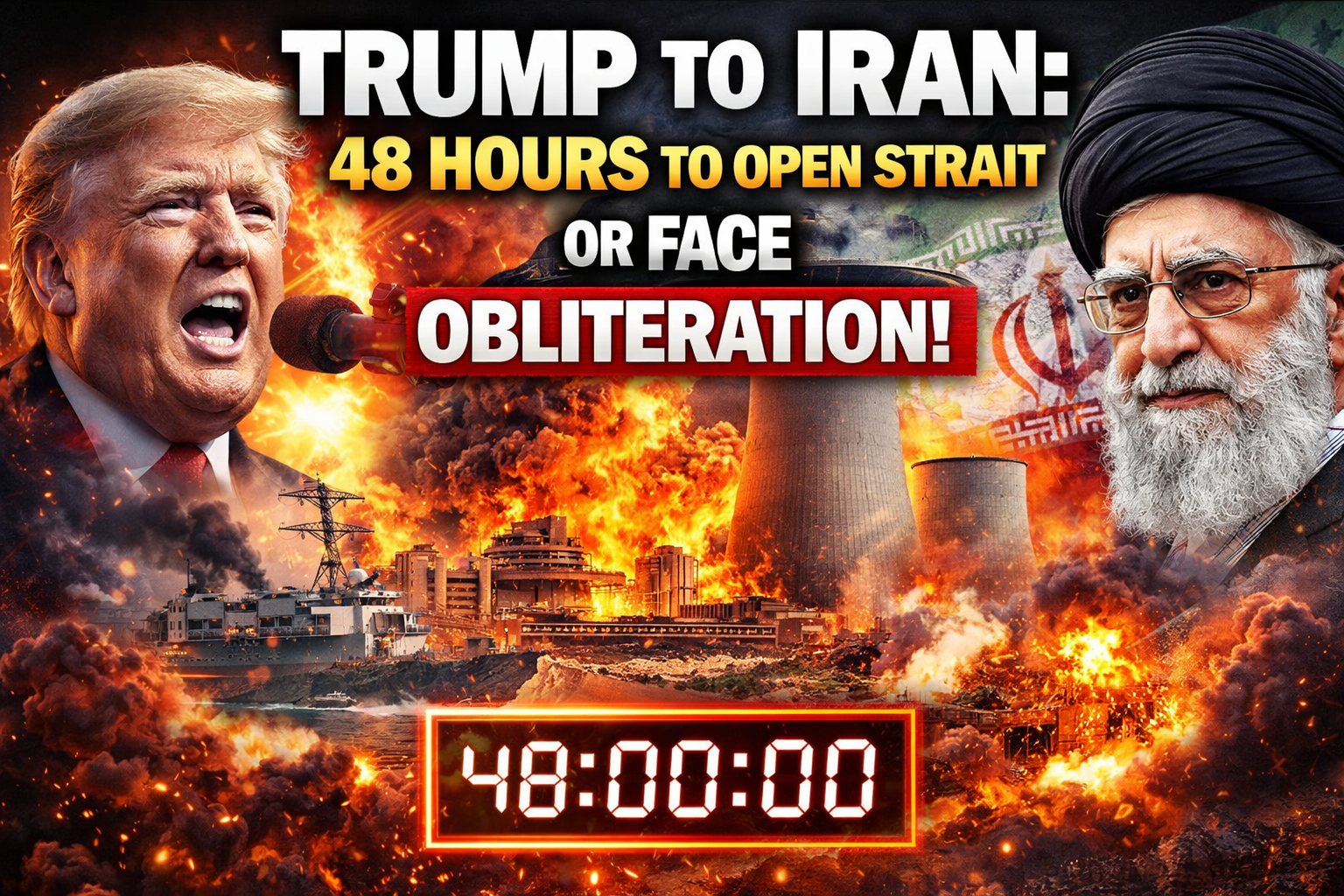
The standoff between the United States and Iran just escalated to a level not seen in decades.
President Donald Trump issued a direct and unambiguous ultimatum: reopen the Strait of Hormuz within 48 hours—or face devastating military consequences.
“If Iran doesn’t FULLY OPEN, WITHOUT THREAT, the Strait of Hormuz… the United States of America will hit and obliterate their various POWER PLANTS,” Trump declared, adding that strikes would begin with the largest facilities first.
The message was not diplomatic. It was strategic, and unmistakably coercive.
At the center of the crisis is the Strait of Hormuz, one of the most critical chokepoints in the global economy. Roughly a fifth of the world’s oil supply passes through this narrow corridor. Any disruption sends immediate shockwaves through energy markets, shipping routes, and geopolitical stability.
And Iran has been pushing that pressure point hard.
In recent days, Tehran has been accused of targeting civilian shipping vessels, launching drone and missile attacks, and interfering with vital oil and gas infrastructure across the الخليج region. Even more provocatively, Iranian officials have floated the idea of charging tolls for passage through the strait—a move that would effectively turn an international waterway into a controlled economic weapon.
The international response has been swift—and unusually unified.
More than 20 nations, including the United Kingdom, France, Germany, Japan, and Australia, issued a joint condemnation of Iran’s actions. The statement described the attacks as unacceptable and called for an immediate halt to efforts to disrupt commercial shipping.
They also pointed to established international law.
Under the United Nations Convention on the Law of the Sea (UNCLOS), all vessels—military and civilian—have the right of transit passage through strategic waterways like the Strait of Hormuz, provided they move without delay and without engaging in hostile actions. Iran’s attempts to restrict or monetize access to the strait, legal experts argue, violate both the letter and spirit of that framework.
In other words, this isn’t just a regional dispute. It’s a direct challenge to the rules governing global trade.
Trump’s ultimatum reflects that reality.
Rather than treating the situation as a limited conflict, the administration is framing it as a test case: whether a single nation can unilaterally choke off a critical artery of the global economy without consequences.
The choice presented to Iran is stark.
Reopen the strait and de-escalate—or risk targeted strikes on critical infrastructure, including power generation facilities that underpin the country’s economy and military capabilities.
What makes this moment particularly volatile is the compressed timeline. Forty-eight hours is not a negotiation window—it’s a countdown.
And behind it sits the implicit question: is this a deterrent meant to force compliance, or the final warning before a broader confrontation?
For now, the world is watching the clock.
Because if the Strait of Hormuz remains closed, the consequences won’t be limited to Iran—or even the Middle East. They will ripple across energy markets, supply chains, and financial systems worldwide.
And if the ultimatum is carried out, it could mark the beginning of a conflict with far-reaching and unpredictable consequences.
One way or another, the next 48 hours may reshape the balance of power in one of the most strategically important regions on earth.