

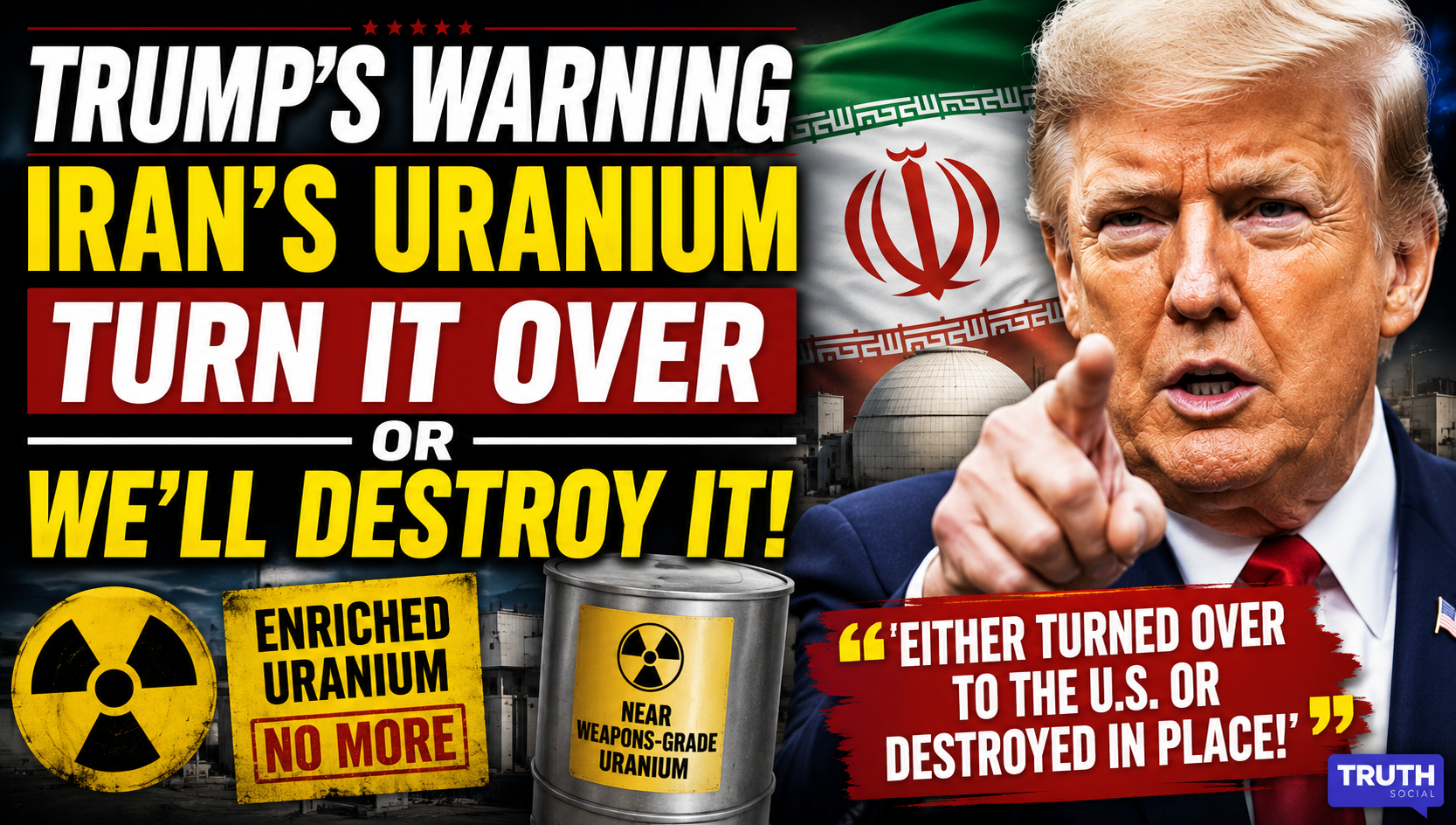
President Donald Trump just drew a hard red line for Iran’s nuclear program, declaring that the regime’s enriched uranium stockpile will either be handed over to the United States or destroyed outright.
In a Truth Social post Monday, Trump made clear there would be no scenario where Tehran simply keeps near-weapons-grade nuclear material sitting untouched inside the country.
“The Enriched Uranium (Nuclear Dust!) will either be immediately turned over to the United States to be brought home and destroyed or, preferably, in conjunction and coordination with the Islamic Republic of Iran, destroyed in place,” Trump wrote.
The statement marks one of the clearest indications yet that the Trump administration is demanding direct control over Iran’s nuclear stockpile as part of any broader agreement or ceasefire framework.
Iran Appears to Be Backtracking
Trump’s comments came after reports over the weekend suggested Iran may already be quietly backing away from its previous hardline position.
According to a report from the The New York Times, two U.S. officials claimed Iran had broadly agreed to surrender its stockpile of near-weapons-grade uranium, a major breakthrough after months of escalating tensions.
That would represent a dramatic reversal.
Just days earlier, Reuters reported that senior Iranian officials insisted Supreme Leader Mojtaba Khamenei had ordered that the enriched uranium “should not leave the country.”
“The consensus within the establishment is that the stockpile of enriched uranium should not leave the country,” one Iranian source reportedly told Reuters.
Now, however, pressure from Washington may be forcing Tehran into a corner.
Trump’s Strategy Is Clear
Unlike previous administrations that often focused on promises, inspections, or future compliance mechanisms, Trump appears focused on physical control and destruction of the material itself.
That matters because enriched uranium is the critical ingredient needed for nuclear weapons development.
Critics of the Obama-era Joint Comprehensive Plan of Action long argued the agreement merely delayed Iran’s nuclear ambitions while allowing the regime to preserve much of its infrastructure and expertise.
Trump withdrew from that deal during his first term, calling it one of the worst agreements ever negotiated.
Now, his second administration appears determined to ensure Iran cannot simply pause its nuclear program temporarily while preserving the capability to restart it later.
By insisting the uranium itself be surrendered or destroyed, the administration is signaling that symbolic agreements are no longer enough.
A Massive Geopolitical Shift
If Iran ultimately agrees to relinquish its enriched uranium stockpile, it would mark one of the most significant Middle East developments in years.
It would also represent a major political victory for Trump, who has repeatedly argued that maximum pressure, economic leverage, and credible military deterrence are more effective than prolonged diplomatic concessions.
The stakes could hardly be higher.
For decades, fears of a nuclear-armed Iran have shaped American foreign policy, Israeli security planning, Gulf State alliances, and the broader balance of power across the Middle East.
Now, the world may be watching the beginning of the most aggressive rollback of Iran’s nuclear program in modern history.