

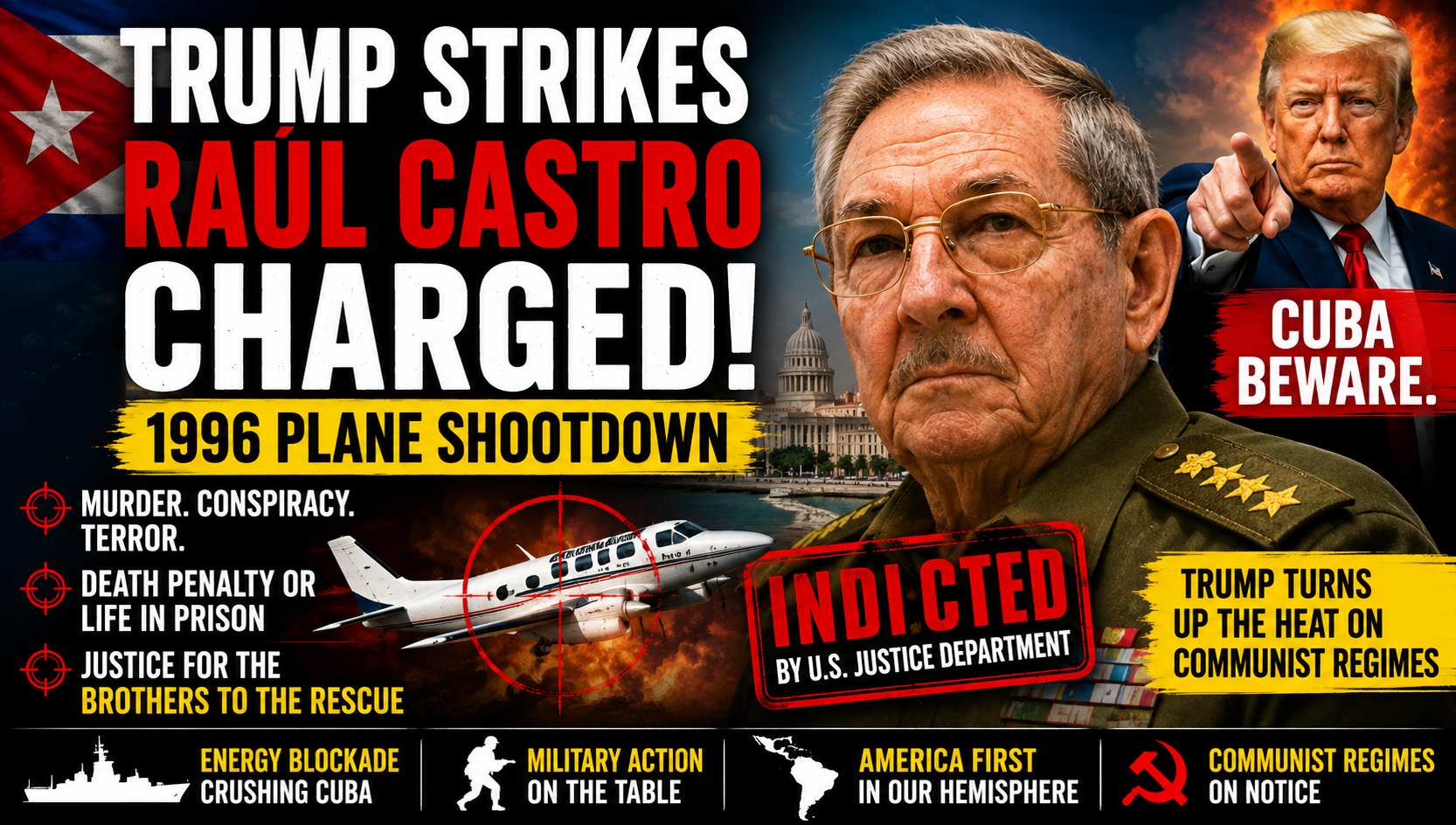
The Trump administration just detonated a political bombshell in the Western Hemisphere.
Federal prosecutors have formally charged former Cuban leader Raúl Castro over the 1996 shootdown of civilian planes flown by the Miami exile group Brothers to the Rescue — a move that signals Washington is no longer treating the Cuban regime as untouchable.
The charges are staggering.
Castro is accused of murder, conspiracy to kill U.S. nationals, and destruction of aircraft — offenses that theoretically carry the death penalty or life in prison.
For decades, many Cuban-Americans believed accountability for the 1996 killings would never come. Now, nearly 30 years later, the Justice Department has effectively declared open season on one of the last surviving architects of the Cuban Revolution.
And this is not happening in isolation.
The indictment arrives as President Donald Trump dramatically intensifies pressure on communist governments across Latin America. Since the reported collapse of Nicolás Maduro’s regime in Venezuela, the White House has imposed what critics describe as a crippling energy blockade on Cuba, choking fuel supplies and accelerating blackouts and economic collapse across the island.
Trump has also openly floated the possibility of military action.
Speaking Wednesday at the Coast Guard Academy, Trump referenced “the shores of Havana” while promising to drive out “foreign encroachment” across the hemisphere.
In Miami, the reaction was explosive.
Supporters applauded as Acting Attorney General Todd Blanche announced the charges against Castro during a memorial event honoring those killed in the 1996 attack. Attendees reportedly rose to their feet, shouted, and pulled out phones to record the moment.
Florida Republicans immediately framed the indictment as long-overdue justice.
Rep. Mario Díaz-Balart declared that “the day of justice is finally arriving” for the Castro family, while Rep. María Elvira Salazar warned the regime that “your days are over.”
Meanwhile, Cuba’s communist leadership responded with fury.
Cuban President Miguel Díaz-Canel denounced the indictment as a fabricated pretext for American military aggression, accusing Washington of manipulating the 1996 incident to justify regime change.
Senior Communist Party officials went even further, promising Cubans would defend Castro’s “legacy at any cost.”
That language alone reveals how seriously Havana is taking the threat.
For years, many assumed America’s Cold War confrontation with Cuba had effectively ended. But Trump appears to be reversing that assumption completely.
The administration is now simultaneously:
- targeting Cuban officials criminally,
- tightening economic pressure,
- threatening cartel-style military operations across Latin America,
- and reshaping the region around an openly America-first doctrine.
The broader geopolitical timing is impossible to ignore.
As Trump escalates pressure on Cuba, China’s Xi Jinping and Russia’s Vladimir Putin are strengthening ties in Beijing, signing dozens of new agreements involving energy and strategic cooperation.
In other words, the world is rapidly reorganizing into competing blocs again.
And Cuba — long a symbol of anti-American resistance in the hemisphere — suddenly finds itself directly back in Washington’s crosshairs.
The indictment of Raúl Castro may never result in a courtroom appearance.
But politically, that almost does not matter.
The message has already been sent:
The Trump administration is no longer treating the old communist order in Latin America as permanent.