

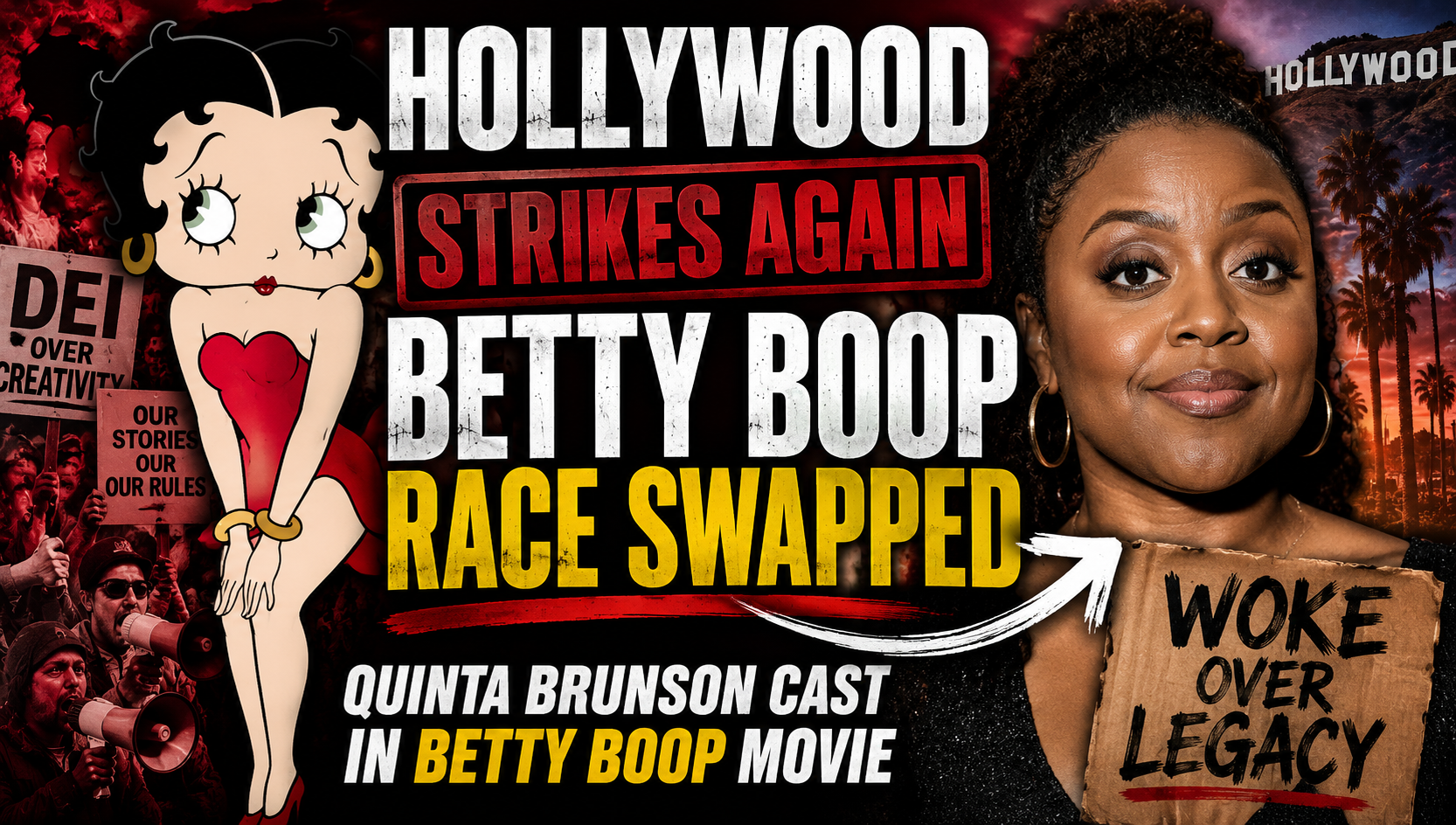
For years, Hollywood executives insisted audiences would eventually embrace endless race-swapping, identity rewriting, and ideological casting experiments. Instead, viewers increasingly rejected the formula. Box office disappointments piled up. Franchises lost momentum. Audiences grew exhausted with being lectured by studios more interested in political signaling than storytelling.
Apparently, none of that mattered.
Now Hollywood has decided that even Betty Boop is no longer safe from reinvention.
According to reports, actress and producer Quinta Brunson is attached to star as Betty Boop in a new feature film connected to Fleischer Studios. The iconic cartoon character, originally created in 1930 by animator Max Fleischer, was famously designed as a white Jazz Age flapper inspired by early Hollywood and vaudeville culture.
Now, nearly a century later, Hollywood appears determined to reinterpret the character through the lens of modern identity politics.
The decision arrives after years of increasingly aggressive casting changes across entertainment, where studios have repeatedly replaced historically European characters with actors chosen primarily to satisfy ideological diversity standards rather than preserve original source material. Whether audiences objected to these changes often seemed irrelevant to executives and media activists, who frequently dismissed criticism as backward or reactionary.
But audiences have noticed the pattern.
The frustration is not simply about race. It is about creative exhaustion.
Instead of building new iconic characters, Hollywood increasingly cannibalizes existing ones. Rather than creating fresh stories rooted in diverse cultures, traditions, and histories, studios often take established Western characters and retrofit them to fit current political narratives. To many viewers, it feels less like creativity and more like corporate ideological repackaging.
Betty Boop is the latest example.
The irony is particularly striking because Betty Boop was already a product of early American cultural fusion. The character emerged from the jazz era, vaudeville, and evolving animation traditions of the 1920s and 1930s. Over the years, some activists attempted to retroactively claim that Betty Boop herself was originally black, citing performer Esther Lee Jones, known as “Baby Esther.”
That narrative eventually collapsed under scrutiny.
Even PBS later clarified there was no evidence Max Fleischer knew Baby Esther or directly based Betty Boop on her. The confusion largely stemmed from singer Helen Kane’s famous “boop-oop-a-doop” style, which itself may have been influenced by Baby Esther’s performances. A famous 1930s lawsuit explored those questions in court, but the idea that Betty Boop was secretly intended as a black character has never been historically substantiated.
Yet Hollywood seems eager to blur those distinctions anyway.
What makes this trend increasingly unpopular is that audiences can sense when legacy characters are being altered primarily for political symbolism rather than artistic necessity. Viewers are not stupid. They understand when studios are chasing headlines, activist praise, or social media approval.
And lately, that strategy has not been going well.
Disney’s string of controversial remakes and identity-focused reinterpretations generated massive backlash in recent years. Major franchises that once printed money suddenly faced declining enthusiasm, online ridicule, and underperforming ticket sales. Even entertainment analysts who once aggressively defended these moves have begun quietly acknowledging audience fatigue.
People generally do not mind diversity when it emerges organically through compelling stories and original characters.
What many resent is the growing sense that Hollywood executives no longer trust audiences to connect with timeless storytelling unless every legacy franchise is filtered through modern ideological frameworks.
The deeper problem is creative cowardice.
Hollywood today possesses enormous budgets, unmatched technology, and global distribution power, yet much of the industry seems incapable of creating new cultural icons that resonate naturally with audiences. Instead, studios repeatedly return to established classics because they know recognizable brands already carry emotional investment.
Then they reshape those brands to fit contemporary political trends.
That approach often alienates the very audiences who made those properties valuable in the first place.
None of this means Quinta Brunson lacks talent. By most accounts, she is charismatic, funny, and successful. The issue is not whether she can act. The issue is why Hollywood continually chooses reinvention over originality.
Why not create a new animated icon inspired by black jazz culture, Harlem Renaissance aesthetics, or the extraordinary history of early black performers themselves?
Why must every cultural update begin with rewriting something that already existed?
Because modern Hollywood increasingly treats legacy art less as something to preserve and more as raw material for ideological repurposing.
And audiences are getting tired of it.