

For years, the corporate media operated under a simple assumption:
Billionaires were supposed to endlessly subsidize ideological activism disguised as journalism.
Now even Jeff Bezos appears tired of writing the checks.
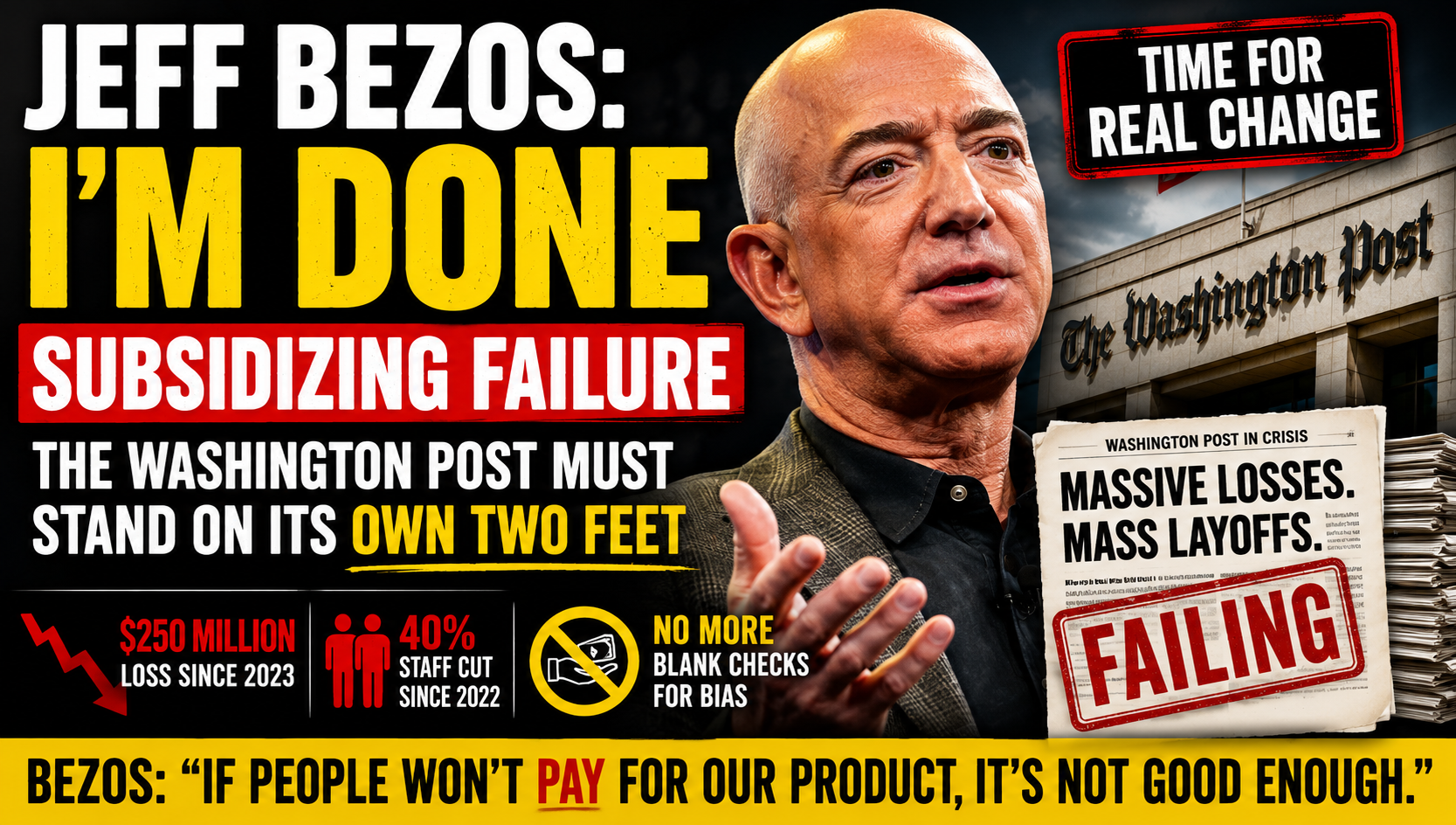
During a tense CNBC interview Wednesday, Bezos bluntly acknowledged what everyone already knew: the The Washington Post is hemorrhaging money and cannot continue surviving as a vanity project for wealthy elites. According to reports, the paper has reportedly lost roughly a quarter of a billion dollars since 2023 while slashing around 40 percent of its staff since 2022.
Yet CNBC’s Andrew Ross Sorkin still seemed shocked that Bezos might want the paper to function like an actual business.
“Why lay people off?” Sorkin asked. “Why don’t you subsidize the business?”
That question perfectly captures the mindset that helped destroy trust in legacy media in the first place.
The assumption is no longer that newspapers should produce journalism readers willingly support. The assumption is that billionaires should simply absorb infinite losses in order to preserve politically useful institutions.
Bezos was having none of it.
“The Post needs to be a profitable enterprise that stands on its own two feet,” he replied.
When Sorkin pushed back again — “But does it?” — Bezos delivered the line that probably sent panic through newsrooms across Manhattan and Washington:
“If people won’t pay for our product, we’re not doing a good enough product.”
That statement cuts directly to the core problem facing modern corporate journalism.
Americans stopped trusting institutions like the Washington Post because those outlets increasingly stopped behaving like neutral news organizations and started functioning like ideological enforcement mechanisms.
Readers noticed.
Coverage became more partisan.
Narratives became more coordinated.
Mistakes became more ideological.
And dissenting viewpoints were increasingly treated as moral failures rather than legitimate disagreements.
The result was catastrophic credibility collapse.
The Washington Post once helped expose Watergate. Today, much of the public associates it with anonymous intelligence leaks, activist framing, and endless Trump obsession.
Even Bezos openly pointed to the success of the The New York Times as proof that newspapers can still make money. But that comparison reveals another uncomfortable reality about the state of modern media.
The Times is profitable largely because it evolved beyond journalism itself.
Its cooking sections, games, lifestyle content, recipes, product reviews, and subscription ecosystem now help prop up the actual newsroom. In many ways, modern newspapers survive less as news institutions and more as elite lifestyle brands with journalism attached.
And even then, the political cost has been enormous.
As legacy outlets became increasingly dependent on narrow ideological subscriber bases, many stopped reporting news objectively and instead began feeding audiences the narratives they already wanted to hear.
That may keep subscriptions alive temporarily.
But it also destroys long-term public trust.
Bezos now seems to understand that endless ideological subsidy is not a sustainable business model.
The bigger question is whether the rest of the media industry understands it yet.
Because once audiences stop believing your institution tells the truth, no amount of billionaire money can permanently save you.