

A shocking healthcare fraud case out of Florida is raising serious questions about how easily foreign nationals and criminal operators can exploit taxpayer-funded programs worth billions of dollars.
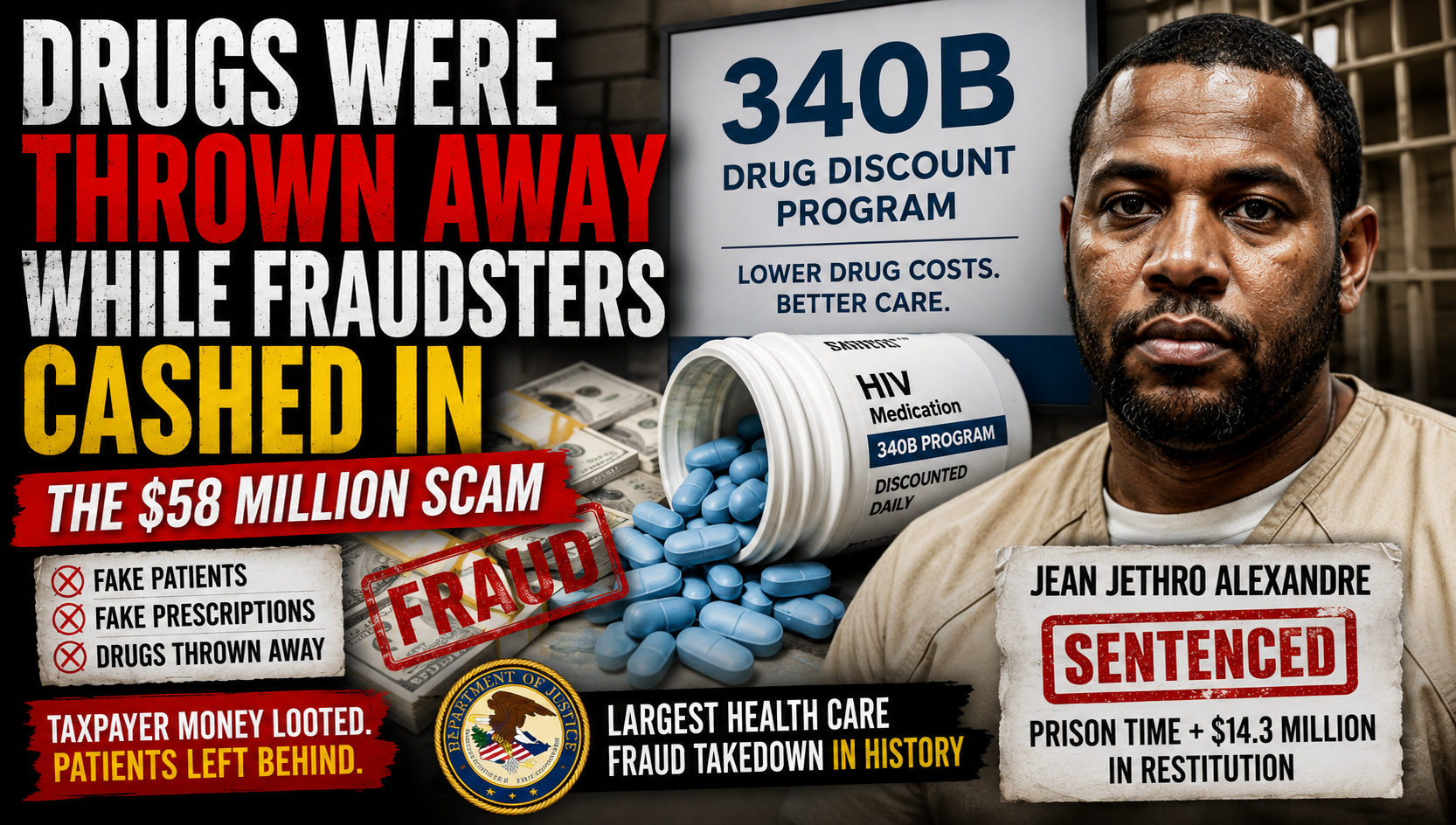
Federal prosecutors recently secured the conviction of Haitian national Jean Jethro Alexandre, who was sentenced to prison and ordered to pay $14.3 million in restitution after orchestrating a massive scheme that allegedly siphoned tens of millions of dollars from the federal government’s 340B Drug Discount Program.
The case wasn’t a sophisticated cyberattack or a hidden accounting trick. According to prosecutors, it was a brazen operation that exploited weak oversight and a system flooded with taxpayer money.
On paper, Alexandre’s clinics existed to treat patients suffering from HIV and other sexually transmitted diseases. In reality, prosecutors say the facilities functioned as prescription mills designed to harvest heavily discounted HIV medications available through the 340B program.
The allegations are staggering.
Federal investigators say recruiters were paid to bring in fake patients. Prescriptions were generated. Drug records were falsified. Medications were allegedly discarded rather than distributed to those in need. Meanwhile, the clinics billed the system as though legitimate medical services had been provided.
The result was an estimated $58 million fraud scheme built almost entirely around exploiting government subsidies.
What makes the case especially alarming is how simple the scam appears to have been.
The 340B Drug Discount Program was originally created to help hospitals and clinics serving low-income patients purchase medications at reduced prices. Supporters argue the program expands access to healthcare for vulnerable populations.
But critics have long warned that the program’s explosive growth has far outpaced its oversight.
Since 2010, purchases made through the program have ballooned from roughly $5 billion annually to more than $66 billion. That massive increase has created a target-rich environment for fraudsters looking to cash in on taxpayer-funded healthcare spending.
The Florida case appears to confirm those fears.
According to prosecutors, life-saving HIV medications intended for struggling patients became little more than inventory used to generate fraudulent reimbursements. Taxpayer dollars flowed. The drugs were allegedly thrown away.
Now, calls are growing for federal officials to investigate whether similar schemes are operating elsewhere across the country.
Supporters of stronger oversight argue the Alexandre case is unlikely to be an isolated incident. Whenever billions of dollars move through a system with limited verification and weak accountability, bad actors inevitably follow.
The White House Fraud Task Force, chaired by Vice President JD Vance and FTC Chairman Andrew Ferguson, was created to identify exactly these kinds of abuses. The question now is whether investigators will treat the Florida case as a one-time scandal or as evidence of a much larger problem hiding in plain sight.
For taxpayers, the lesson is hard to ignore.
Programs designed to help vulnerable Americans can quickly become magnets for corruption when accountability takes a back seat to spending. And as this case demonstrates, the people who ultimately pay the price are not the fraudsters. It’s the taxpayers funding the system and the patients the program was supposed to serve.